

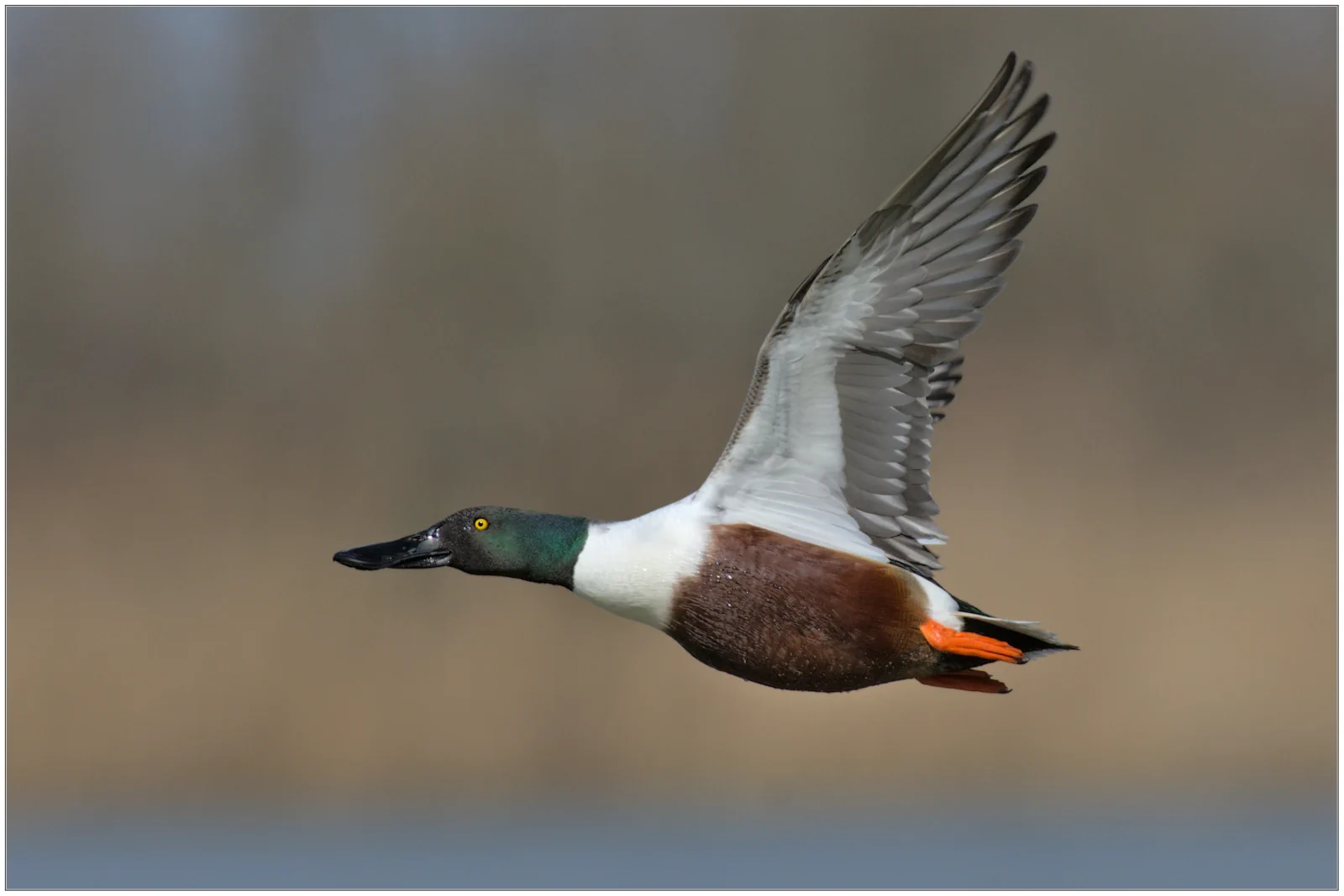
The Northern Shoveler is one of the most recognisable and most elegant ducks of our wetlands. With its broad, flat bill widening at the tip like a spoon or a spatula, it leaves no room for doubt: it is the only European duck equipped with such a peculiar tool. The male in breeding plumage is a natural poster: a glossy green head, an immaculate white breast, chestnut flanks, a black back and a black tail edged with white tips, all enhanced by a fine white collar separating the breast from the neck. The female, more discreet, wears the speckled brown mantle common to the females of many ducks, but her widened bill betrays her instantly. It is found in shallow freshwater, marshes, ponds, brackish lagoons, mudflats and floodplains, wherever its specialised bill allows it to filter water and sediments in search of micro-organisms. The Northern Shoveler is a bird of filtration and invertebrates, having traded vegetarian grazing for the sieving of muddy water.
Yet behind this remarkable bill hides an anatid with unsuspected resources. The Northern Shoveler is not merely "the duck with the strange bill": it is an expert filter-feeder that uses the lamellae lining its bill to strain prey from water and particles, a partial migrant whose northern populations move down to our regions at the first frost, a wet-meadow nester that builds its nest on the ground far from the water, and a sensitive indicator of the quality of wetlands and of their wealth of aquatic invertebrates. Observing it is to understand that not all ducks are grazers, and that some have developed extraordinary adaptations to exploit the invisible resources of turbid water.
Classification
The Northern Shoveler belongs to the Anatidae family, which brings together the ducks, geese and swans of the world (more than 170 species found on every continent except Antarctica). It is one of the representatives of the genus Spatula, which includes the shovelers and their close relatives (formerly placed in the genus Anas). The scientific name clypeata means "bearing a shield", referring to the broad bony plate of the bill. It is an omnivorous bird, mainly a filter-feeder on invertebrates, tied to shallow aquatic habitats: marshes, ponds, lagoons, mudflats and floodplains. Several subspecies are recognised across its Eurasian and American range, but only one breeds in western Europe: Spatula clypeata clypeata.
Identification
The Northern Shoveler is a medium-sized duck, slightly smaller than the Mallard. Its length is about 44 to 51 cm, for a wingspan of 70 to 80 cm and a weight of 600 to 1,000 grams (females being slightly lighter). Sexual dimorphism is pronounced in breeding plumage. The male has a glossy green head with a violet sheen, an immaculate white breast, chestnut flanks, an ash-grey back, a black belly and black undertail-coverts edged with white. The bill is very broad, flattened and widened at the tip like a spatula (about 6 to 7 cm long and 3 cm wide at the tip), black with a reddish tip. The legs are greyish. The female is speckled brown, with the characteristic widened bill though less pronounced than the male's, a white patch around the eye and a pale band on the flanks. Immatures resemble the female but are duller, with a narrower bill. In eclipse plumage, the male loses his bright colours and resembles the female, except for the bill, which keeps its distinctive shape. Thanks to the characteristic bill, confusion with other ducks is practically impossible, but the female may be mistaken for a female Mallard or Eurasian Teal; however, the broader bill and stockier silhouette identify the Shoveler.
Calls and songs
The Northern Shoveler is a rather discreet bird outside the breeding season, but vocal during exchanges between partners and at roosts. The female's most typical call is a hoarse, brief "quaac", similar to but quieter than the Mallard's, given in alarm, on take-off and during social encounters. The male produces softer, more whistled notes, descending "pui-pui" sounds, often heard during courtship displays and spring flights. During display, the pair exchanges ritualised vocalisations: the male whistles while the female answers with deeper notes, in a quiet dialogue that strengthens the pair bond. The young give sharp, insistent peeping calls, repeated "pi-pi-pi", to beg from their parents. These calls carry several tens of metres across the wetlands.
Habitat
The Northern Shoveler favours calm, shallow fresh or brackish water (10 to 40 cm deep), rich in aquatic invertebrates. It is found on ponds, marshes, lagoons, mudflats, floodplains, canals, reservoirs and oxbow lakes, wherever emergent vegetation offers both shelter and filtering grounds. It needs two fundamental elements: shallow water with sediments rich in micro-invertebrates (copepods, daphnia, chironomid larvae) and dense vegetation (reeds, bulrushes, cattails) for nesting and cover. Unlike the Mallard, it prefers open water dotted with a few vegetated islets rather than wholly wooded settings. It avoids deep water with no shallow areas, entirely open landscapes without vegetation, turbid water poor in invertebrates, and areas heavily used by people. A pond with a peripheral reedbed and exposed mudflats, a marsh with channels and islets, a lagoon with floodable margins can all constitute suitable habitat. A pair's home range generally covers a few square kilometres. In winter, it frequents a wider range of habitats: estuaries, coastal lagoons, salt pans, large lakes and agricultural reservoirs.
Behaviour
The Northern Shoveler is a sociable bird, gathering in sizeable groups outside the breeding season. On migration and in winter it forms flocks of tens to hundreds of birds, sometimes mixed with other filter-feeding ducks (teals, pochards). Its feeding behaviour is highly specialised: it feeds by filtering water and sediments with its broadened bill, which bears horny lamellae (about 150 to 200 on each mandible) that sieve prey from the water. The Shoveler swings its head upside-down in the water, bill buried in the mud, drawing water in and expelling particles through the sides of the bill while retaining invertebrates in its mouth. This feeding mode, known as filtration or sieving, allows it to exploit resources invisible to other ducks, notably the copepods and cladocerans dwelling in turbid waters. It is wary and vigilant: groups scatter quickly at the slightest disturbance, but can become fairly trusting within protected areas. During nesting it becomes territorial: the pair defends a small area around the nest, driving away intruders with pursuits on the water and hoarse calls. The Northern Shoveler is a partial migrant: northern and central European populations leave their breeding quarters as early as September-October for the Mediterranean lagoons, North Africa and the Middle East. The return journey takes place in March-April.
Flight
The flight of the Northern Shoveler is fast, direct and usually low, taken above wetlands and open landscapes. It beats its wings at a rapid, steady rhythm, flying in a straight line between two patches of water. Taking off is relatively easy (unlike heavier ducks): the bird rises from the water or the grass after a short run, with brisk wingbeats. On migration the flight becomes higher and more sustained, often in tight groups or oblique lines. The Northern Shoveler travels by day and by night, crossing the Mediterranean and sometimes the Sahara for northern populations, and settles at dawn in wetlands to rest. This is why it is often seen on active migration: spring and autumn movements are regular along the major flyways and at the great French stopover sites (Camargue, Languedoc lagoons, Baie de Somme, Rhône valley).
Feeding
The Northern Shoveler is a filter-feeding omnivore whose diet is dominated by aquatic micro-invertebrates. Its food varies with the season and local availability of prey. In the breeding season, it feeds mainly on aquatic invertebrates: copepods, daphnia, cladocerans, chironomid larvae, mosquito larvae, small molluscs, aquatic worms and fish eggs. It also takes small crustaceans, algae and seeds of aquatic plants as a supplement. In winter it eats more plant matter: seeds of aquatic plants, tender leaves, roots and rhizomes, alongside whatever invertebrates are available. It feeds by filtering water and sediments, either with the head submerged in shallow water or by picking at exposed mudflats. The young receive protein-rich prey during their first weeks (mainly insect larvae and small crustaceans), essential for their rapid growth.
Breeding and nesting
Nesting begins in spring, from May-June in northern regions, earlier in temperate ones. The pair builds a nest on the ground, often tens or hundreds of metres from the water, in wet meadows, woodland clearings, roadside margins, hedgerows and waste ground, far from the water unlike most ducks. It is a simple cup made of grasses, dead leaves, moss and down plucked from the female's breast. The nest is concealed under a tuft of grass or in a natural hollow, forming an effective camouflage screen. The female usually lays 7 to 12 eggs, cream-beige spotted with rufous-brown, perfectly camouflaged against the surrounding litter. Incubation lasts about 22 to 25 days, carried out mainly by the female, while the male keeps watch nearby. After hatching, the young are nidifugous: they leave the nest almost immediately, follow the mother to the nearest water, and can dive and swim from their first day. Both parents take part in protecting the young, which take wing after 5 to 6 weeks and become independent soon afterwards. One clutch per year is the rule, but a replacement clutch may be laid if the first fails early.
Distribution
The Northern Shoveler has a vast range covering much of temperate and boreal Eurasia, from western Europe to eastern Siberia, along with isolated populations in North America and the Maghreb. In Europe, it breeds from the Iberian Peninsula to Scandinavia and Russia, with high densities in the wetlands of eastern and central Europe (Hungary, Poland, the Baltic states, Finland). Northern populations are migratory and winter in south-western Europe, the Mediterranean basin, North Africa and the Middle East. In France, it is a localised breeder but present across the country (Camargue, Brenne, Dombes, Poitou ponds, Baie de Somme, Rhine valley, Corsica), with a population estimated between 3,000 and 7,000 breeding pairs depending on the year. The wintering population is larger: several thousand individuals spread over the major water bodies of southern France, reinforced by northern and central European birds. The Northern Shoveler is thus a localised breeder and a winter visitor in France, with peak numbers in winter on the lagoons and large southern ponds.
Threats and protection
The Northern Shoveler remains classified as "Least Concern" (LC) by the IUCN at global level, with populations globally stable or slightly increasing in some regions. In France, it is included on the list of protected species and on Annex I of the European "Birds" Directive. The threats weighing on the species are the destruction and degradation of wetlands through drainage, drying out and urbanisation, eutrophication and water pollution by nitrates and pesticides (which reduce the availability of aquatic invertebrates), altered water levels during nesting (flooding or premature drying of breeding meadows), human disturbance (tourism, hunting, pleasure boating), collisions with power lines and wind turbines on migration, and intensive shooting in some wintering countries (North Africa, Middle East). Climate change could shift the timing of invertebrate emergence and desynchronise duck breeding. Protecting the Northern Shoveler means preserving and restoring wetlands, keeping water levels stable during the nesting season, managing ponds and marshes extensively, scientifically monitoring breeding and wintering populations, and limiting hunting pressure in sensitive areas.
To observe a Northern Shoveler is first to notice the bill, then to forget everything else. That peculiar bill, widened like a spatula, cannot be seen from afar, but it can be guessed at by the way the bird plunges its head into the water and holds it still, the body floating peacefully, as if in a trance. Then, when the male appears in breeding plumage, it is an explosion of colour (glossy green on the head, pure white on the breast, chestnut on the flanks) contrasting with the neutral tones of other ducks. But what strikes most is the paradox of this specialisation: while most ducks graze on plants or sift sediments in the manner of teals, the Shoveler filters water like a living net, exploiting resources nobody can see or touch, billions of micro-invertebrates dancing in the turbid water. Where it breeds, there are rich wetlands, abundant invertebrates, preserved floodable meadows and a tranquillity that few habitats still offer. Behind its broadened bill, its bright colours and its filter-feeding ways, the Northern Shoveler remains a bird of paradoxes (a specialist yet an omnivore, nesting far from water yet dependent on wetlands, a partial migrant yet faithful to its sites), whose presence signals living wetlands of remarkable quality. And every filtering silhouette at dusk is a promise: the promise that marshes still rich enough, calm enough and shallow enough remain, to shelter the most singular of our ducks.