

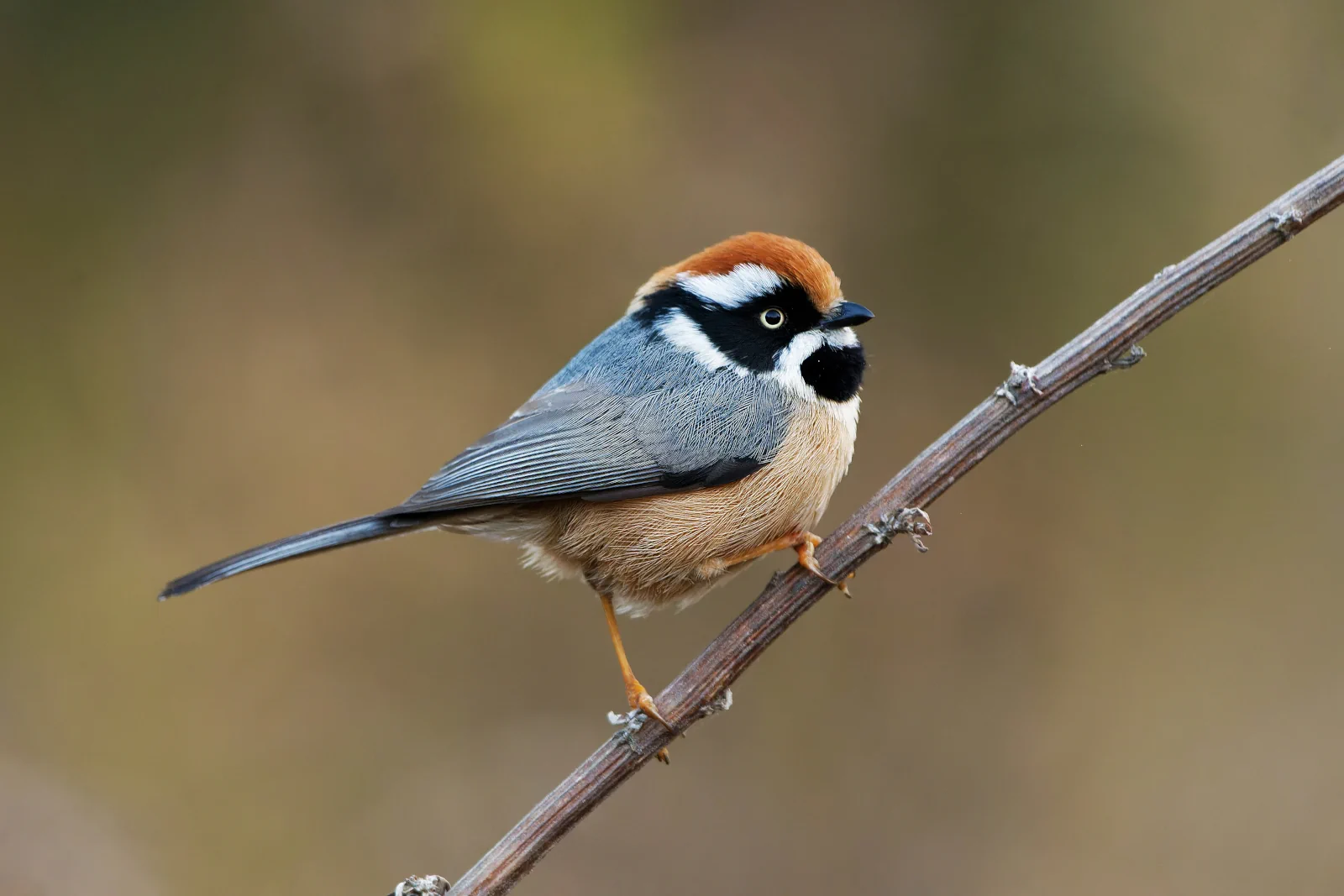
The Black-throated Tit (also known as the Black-throated Bushtit or Red-headed Tit, Aegithalos concinnus) is one of the most charming and instantly recognizable songbirds of Asia's mountain forests. Barely ten centimetres long, it wears a jewel-like combination of colours: a bright chestnut-red crown and nape, a bold black mask sweeping across the eyes and down to the throat (which gives the species its English name), snowy-white cheeks and underparts, a chestnut breast band, and blue-grey upperparts. It lives almost permanently in small, restless flocks that thread through the canopy, hanging upside-down and probing every leaf in search of tiny insects, announcing their presence with continuous high-pitched twittering that carries far through the forest. In Taiwan, it holds a special status: it is the island's only known native member of the bushtit family (Aegithalidae), and one of the most common and beloved birds of its mid-elevation forests, from Alishan to the Central Mountain Range. Seeing a flock of these tiny, fierce-eyed "little tigers" (their local nickname) working through a moss-draped oak is one of the purest pleasures of Asian mountain birding.
But behind this adorable exterior lies a songbird of remarkable sophistication. The Black-throated Tit is not merely "the little red-and-black bird of the high forests": it is a highly social forager whose flocks huddle together through cold mountain nights, a master weaver that builds an elastic pouch-like nest from moss, lichen and thousands of spider webs, a year-round resident that manages harsh winters through seasonal altitudinal descent, and (most remarkably) a cooperative breeder, in which young birds from previous broods stay on to help their parents raise the next generation. Watching this species is watching an entire miniature society at work.
Classification
The Black-throated Tit belongs to the family Aegithalidae, the bushtits and long-tailed tits, a small group of tiny, highly social songbirds distributed across Eurasia and North America (about a dozen species worldwide). It is placed in the genus Aegithalos, alongside the familiar Long-tailed Tit (Aegithalos caudosus) of Europe. The scientific name concinnus means "elegant" or "neatly arranged" in Latin, a fitting tribute to its crisply delineated plumage pattern. It is a strictly insectivorous bird, tied to mountain forests of southern and eastern Asia, from the Himalayas eastward to central China and southward to mainland Southeast Asia and Taiwan. Five to six subspecies are usually recognized (sources vary depending on the treatment), differing mainly in the extent of the black throat and the intensity of the chestnut; the Taiwanese population is generally assigned to the nominate subspecies A. c. concinnus, though recent literature should be checked on this point.
Identification
The Black-throated Tit is one of the smallest passerines in Asia, comparable in size to the European Long-tailed Tit. Its total length is about 10 to 11 cm (nearly half of which is tail), for a body weight of only 4 to 9 grams. There is little or no sexual dimorphism visible in the field. The adult's head is beautifully patterned: the crown and nape are rich chestnut, a broad black stripe runs from the bill through the eye and expands over the throat (the "black throat" of its English name), the cheeks and underparts are white, a chestnut breast band crosses below the white throat patch, and the back and wings are dark blue-grey. The bill is short, fine and black. The legs are short and dark. Immature birds replace the chestnut crown with grey and lack the black throat patch (a useful ageing feature in the field). Confusion with other species is unlikely: within its range, the combination of rufous crown, black mask and throat, and pale underparts is diagnostic, and in Taiwan the species is quite alone among its family, being the island's sole native Aegithalid.
Calls and sounds
The Black-throated Tit is a highly vocal species, nearly always heard before it is seen. Flock members maintain contact through an almost continuous stream of thin, high-pitched metallic notes ("tsit-tsit-tsit"), allowing scattered individuals to track one another through dense foliage. When a predator such as a raptor or a jay approaches, the flock erupts into rapid, piercing alarm calls before dissolving into the nearest cover. During the breeding season, mates exchange soft, low murmurings at the nest, and fledglings utter persistent thin begging calls. Because these birds live in tight groups year-round, their collective chatter is one of the defining soundscapes of Asia's mid-elevation forests.
Habitat
The Black-throated Tit favours forested mountains: broadleaf forests, mixed conifer-broadleaf woods, forest edges, scrubby thickets, orchards and well-vegetated parkland. It occupies mainly mid to high elevations (roughly 300 to 3,000 metres across much of its range) and shows a marked seasonal pattern: in Taiwan it is a widespread resident of mid-altitude forests, descending to lower mountain slopes in winter to escape the cold. Two habitat features are essential: dense canopy or scrub offering foraging surfaces and concealment, and an abundant supply of invertebrate prey on foliage. It avoids intensively farmed lowlands, treeless alpine grasslands and heavily disturbed areas. A single stretch of healthy mid-elevation broadleaf forest with rich insect life can support a substantial population.
Behaviour
This is a quintessentially gregarious species, living year-round in cohesive flocks of a handful to a dozen or more birds. The flock moves constantly and rapidly: individuals dangle from twig tips, probe both sides of leaves, hang upside-down in tit-like fashion, and communicate endlessly through contact calls. At night and in cold weather, flock members huddle shoulder-to-shoulder on a branch to conserve heat (an important energy-saving strategy at altitude). When alarmed, the flock scatters into dense vegetation with sharp alarm calls, then regroups nearby. During the breeding season, pairs hold small territories around the nest, but they tolerate and even benefit from the presence of helpers (young birds from the previous year, which frequently remain with their parents and assist in feeding the new brood, a classic example of cooperative breeding in birds). The species is sedentary, with seasonal altitudinal movements rather than true migration: as winter deepens, flocks drift downhill to milder elevations, returning upward in spring.
Flight
The flight of the Black-throated Tit is light, fast and fluttering, often compared to that of a large insect. It beats its wings very rapidly but covers only short distances, flitting from bush to bush and from tree to tree in slightly undulating bursts. Take-off is instantaneous and silent: a few rapid wingbeats carry the bird into the next shrub, where it vanishes into the foliage. It is not built for sustained or long-distance flight; even its winter downslope movements are achieved gradually, hop by hop, along continuous tracts of forest.
Feeding
The Black-throated Tit is essentially a strict insectivore. Its diet consists of small arthropods gleaned from foliage and twigs: aphids, small caterpillars, tiny beetles, spiders and spider eggs, supplemented occasionally by honeydew, sap or small berries. It forages with restless energy, working systematically through branches, inspecting both surfaces of every leaf, often hanging upside-down or dangling at the tips of the outermost twigs. This diet makes it a valuable natural ally of mountain forests, helping to suppress outbreaks of defoliating insects. Chicks are fed primarily on soft caterpillars and aphids, delivered by both parents and (in many nests) by additional helpers.
Breeding and nesting
The breeding season runs from spring into early summer (roughly March to June, starting later at higher elevations). The nest is one of the most exquisite structures built by any small bird: an elastic pouch of moss, lichen, spider silk and plant fibres, finely woven and suspended from the tip of a thin branch or within dense shrubby cover, usually a metre or a few metres above the ground. It has a small side entrance and a soft inner chamber lined with feathers and plant down. The female typically lays 5 to 7 white eggs, finely speckled with pale reddish-brown. Incubation lasts about 14 to 16 days, carried out mainly by the female while the male guards and feeds her (in some pairs, helpers also participate). After hatching, both parents feed the chicks, frequently aided by birds from previous broods. The young fledge after about 14 to 16 days but remain dependent on adults for some weeks afterwards. Normally only one brood is raised per season, though replacement clutches occur after early failures.
Distribution
The Black-throated Tit ranges across the Himalayan chain (northern Pakistan, India, Nepal, Bhutan), Myanmar, central and southern China, northern Vietnam, and the island of Taiwan, where it is a common resident of mid-elevation forests across the whole island. In Taiwan it is the only known native representative of its family. Globally, the species is classified as "Least Concern" (LC) by the IUCN, with stable overall populations and a very large range. It is absent from lowland tropical forests and intensively farmed plains.
Threats and protection
At the global scale, the Black-throated Tit remains secure, thanks to its wide distribution and stable populations, and is listed as "Least Concern" (LC) by the IUCN. In Taiwan, it benefits from legal protection under the island's Wildlife Conservation Act, which prohibits capture, trade and harm. Local threats nonetheless exist: logging and fragmentation of mid-elevation forests (reducing nest sites and foraging habitat), intensive pesticide use in mountain orchards and farms (eliminating insect prey and risking direct poisoning), and continuing illegal capture for the cage-bird trade in parts of the Asian range. Climate change may push suitable forest belts uphill, progressively reducing available habitat for a species so tightly bound to a narrow elevational range. Conservation priorities include protecting continuous tracts of mid-elevation forest, promoting pesticide-free orcharding and forestry, maintaining habitat connectivity across elevation gradients, and continued monitoring of wild populations.
To encounter a Black-throated Tit is to witness one of nature's smallest fireworks displays. On a quiet mountain trail, the first sign is sound: a flicker of high metallic chirps from somewhere in the canopy. Then, suddenly, the flock materializes: a dozen tiny birds flipping through the moss and lichen, red-crowned, black-masked, hanging upside-down with absolute confidence, endlessly conversing in their thin, bright voices. Their nickname in Taiwan, "little tiger" (小老虎), suits them perfectly: small, boldly striped and unmistakably alive with energy. And when spring arrives, the spectacle becomes even more moving. Hidden in the fork of a slender branch hangs a miniature purse, stitched from moss, lichen and silk, barely larger than a golf ball. Inside it, a female sits tight while her mate and, often, a gang of last year's offspring shuttle back and forth with beaks full of caterpillars. Very few birds in the world breed cooperatively, and fewer still are small enough to disappear entirely into a single leaf cluster. Here, in a bird weighing less than a ballpoint pen, cooperation, family bonds and mountain resilience come together in miniature. Where the Black-throated Tit thrives, the forest is healthy, insect-rich and intact. Behind its toy-like appearance lies a genuine wonder of social evolution (a species that shares, helps and endures together), a gentle reminder that even the smallest creatures build complex worlds. And every burst of thin, metallic calls echoing through a mountain oak forest is a quiet promise: that there are still cool, green forests alive enough to shelter the tiniest, most delightful member of Asia's mountain bird communities.