

Voici les deux versions traduites avec leurs métadonnées SEO, Greg. Version Anglaise (English Version) Meta Title Western Marsh Harrier | Circus aeruginosus | Wetlands Raptor Guide Meta Description Discover the Western Marsh Harrier (Circus aeruginosus): habitat, identification, behaviour, diet, reproduction and conservation in European wetlands. A comprehensive ornithological guide. Keywords western marsh harrier, Circus aeruginosus, wetland raptor, marsh harrier identification, bird of prey Europe, rosy marsh harrier, Circus harrier, wetlands conservation, marsh birdwatching, ornithology guide, European raptors, reedbed habitats, bird migration Africa, harrier nesting habits, wetland biodiversity Content
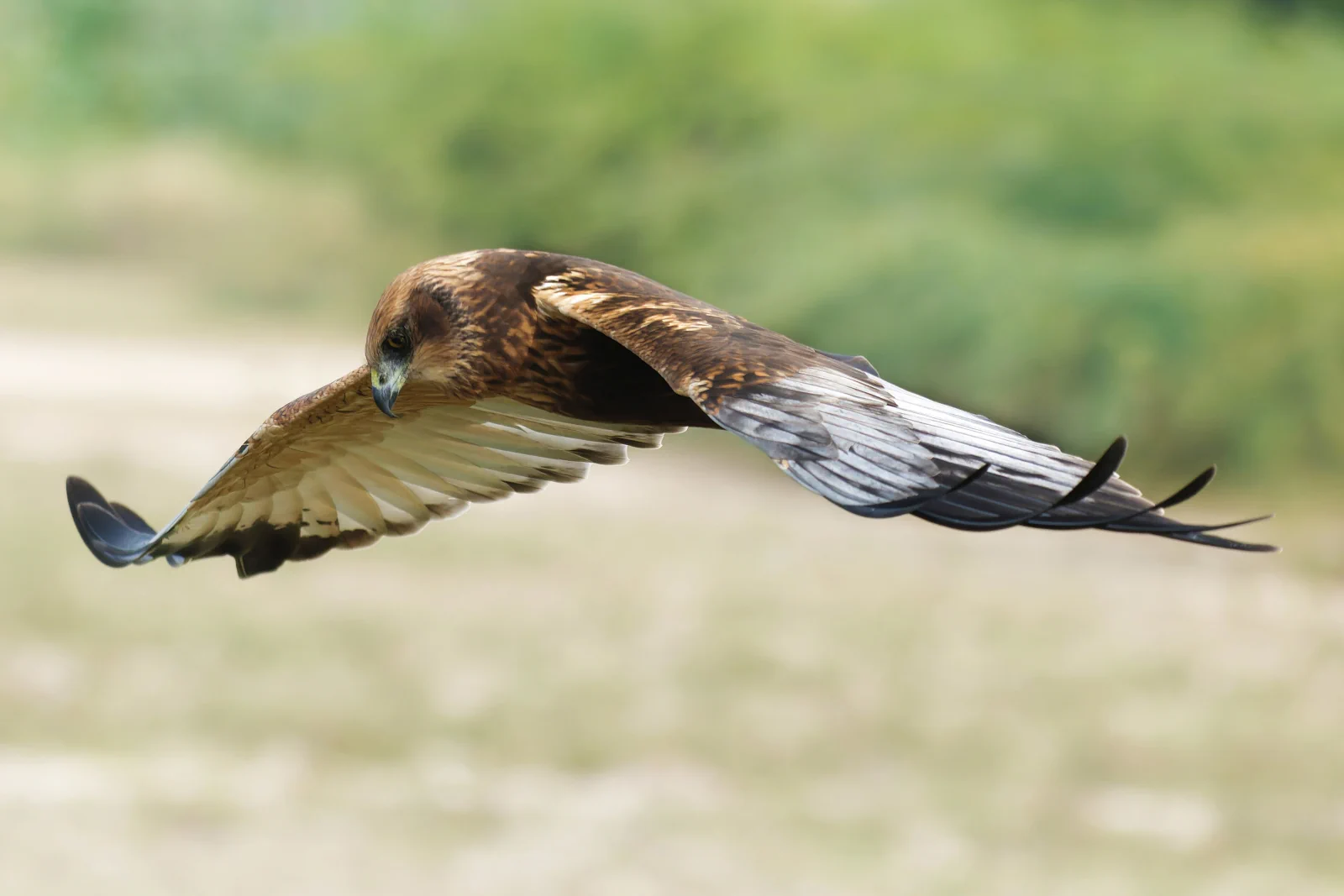
The Western Marsh Harrier is undoubtedly the most emblematic of raptors associated with wetlands. With its slow, low flight, long wings carried in a V-shape, it soars over reedbeds and marshes with sovereign grace, scanning the vegetation for prey. The male, with its warm rufous body, grey wings bordered with black and silver-grey tail, contrasts vividly with the female, a large brown silhouette with a straw-coloured neck, perched among the reeds like a sentinel. But behind this beauty of raptor hides a patient, methodical hunter whose survival depends intimately on the preservation of palustrine environments.
But behind its imposing silhouette lies a raptor with many facets. The Western Marsh Harrier is not merely "the great brown bird of the marshes": it is an opportunistic predator capable of adapting to open agricultural landscapes, a silent hunter with a low-soaring flight, a faithful partner that returns to nest each year in the same location, and a devoted parent who shares incubation and chick-rearing. Observing it means grasping the fragile balance between predator and environment, between power and discretion, and understanding why the preservation of reedbeds is essential to the survival of this emblematic species.
Classification
The Western Marsh Harrier belongs to the family Accipitridae, which includes most diurnal raptors (kites, buzzards, sparrowhawks, eagles). It is the most widespread and best-known harrier in Eurasia. Its genus Circus gathers raptors with low-soaring flight and long wings, adapted to hunting in open terrain. It is a carnivorous bird, closely associated with wetland habitats (marshes, reedbeds, ponds bordered with vegetation, flooded plains) but capable of settling also in cereal crops when reedbeds are scarce. Several subspecies have been described across its range, but only one is widely recognised in Europe (Circus aeruginosus aeruginosus).
Identification
The Western Marsh Harrier is a medium to large raptor, intermediate between a Common Buzzard and a Black Kite. Its length is 43 to 54 cm, with a wingspan of 115 to 130 cm and a weight of 400 to 800 grams. Sexual dimorphism is pronounced and striking. The adult male displays a contrasting plumage: the body is warm rufous-brown, the wings are ash-grey with black primary feathers and a distinctive pale leading-edge border, and the tail is silver-grey. In flight, it shows a streaked rufous and grey underside, with a characteristic black patch at the base of the primaries. The female, larger (up to 1.5 times the male's weight), is almost entirely dark brown, with a striking contrast between the dark body and the crown, throat and anterior wing edges that lean towards straw-yellow or cream. This "straw mask" is the major identification criterion for the female in flight. The irises are yellow in both sexes as adults. The bill is hooked, dark, framed by yellow cere. The legs are yellow, robust, equipped with powerful claws adapted to capturing varied prey. Immatures resemble the female but are more uniformly brown, without the distinctive straw mask, with a warmer chocolate tone. Sex differentiation is reliable only from the second year onwards.
Songs and Calls
The Western Marsh Harrier is relatively quiet outside the nesting period. Its most characteristic call is an acute, nasal "tchiou-tchiou-tchiou", emitted in flight during displays or near the nest. This call can become more urgent and rapid when partners reunite or when an intruder approaches. The female emits at the nest a shrill, repeated "kee-kee-kee" to demand food brought by the male, the latter performing spectacular aerial food transfers in mid-flight. When disturbed, both adults launch more guttural alarm calls, deep, prolonged "kraaa", while diving repeatedly on the intruder. Young at the nest push high, insistent peeps, especially when they perceive an adult returning with prey. These calls grow more powerful as the young mature and their appetite asserts itself.
Habitat
The Western Marsh Harrier favours vast reedbeds bordering ponds, marshes, lagoons and slow rivers. It needs dense, tall vegetation to establish its nest on the ground or among the reeds, as well as open surrounding spaces for hunting: wet meadows, pasturelands, fallows, low crops and cleared banks. It occurs from sea level to middle mountains, but avoids enclosed woodland areas and high altitudes. It systematically seeks the juxtaposition of a nesting site well concealed in thick reedbed and open, prey-rich hunting territories. During migration and wintering, it frequents a broader range of habitats: rice paddies, coastal marshes, deltas, flooded agricultural plains, sabkhas and temporary wetlands. In sub-Saharan Africa, the main wintering area for north-European populations, it occupies savannahs, marshes and crops. The hunting territory of a pair can extend over several square kilometres, depending on prey density and habitat quality.
Behaviour
The Western Marsh Harrier is a patient and methodical hunter. Its characteristic hunting flight consists of flying slowly and low, a few metres above the vegetation, with an undulating trajectory, methodically inspecting the terrain. This low-soaring flight, called "searching flight", allows it to surprise prey on the ground or taking off. It can also remain perched on watch on a post, stump or mound, watching for movements in the grass. It is territorial during nesting: the couple defends its sector against intruders of the same species, but often tolerates other raptors or species provided they do not threaten the nest. In autumn, Marsh Harriers may form communal roosts, sometimes mixed with other harriers, in reedbeds, with numbers reaching several dozen birds. The autumnal migration passage is marked by grouped movements, birds travelling by day, alone or in small groups, using thermal updrafts. It is during these migration periods that the largest concentrations can be observed.
The Flight
The flight of the Western Marsh Harrier is one of the most recognisable in the world of raptors. It flies with wings held in a marked V, beating slowly and regularly, with prolonged glides. This supple, energy-efficient flight enables it to cover large distances over vegetation without tiring. Take-off is easy: it rises from the ground or reeds with a broad movement, without prior running. The male, lighter, is particularly agile and can pivot abruptly to dive on prey spotted. The female, more massive, flies with a heavier gait but is no less effective. During migration, flight becomes higher and more sustained, utilising thermals to cover long distances with minimal effort. The postnuptial migration passage, especially in September-October, can produce remarkable spectacles along passes and wetland zones.
Diet
The Western Marsh Harrier is an opportunistic carnivore. Its diet varies considerably according to habitat, season and local prey abundance. It feeds mainly on small mammals: voles, mice, shrews, and even young rabbits or small mustelids. It also captures birds, especially reed and grassland passerines (reed warblers, buntings, larks), chicks of rallids or ducks, and injured or weakened birds. In wetland zones, amphibians (frogs, toads) and reptiles (snakes, lizards) notably complement its menu. It also consumes large insects (orthopterans, beetles) in summer, and occasionally fish stranded or found in shallow water. Carcasses of small animals are not neglected. The male often hunts alone and brings prey to the female at the nest, transfer sometimes effected in mid-flight by an aerial pass where the female turns under the male to seize the prey from his talons.
Reproduction and Nesting
Nesting begins in spring, from April in southern regions, in May further north. The couple builds a nest on the ground, in the dense vegetation of reeds or sedges, sometimes in wheat or rape crops if reedbeds are unavailable. It is a voluminous platform made of reed stems, twigs and various plant materials, with a central cup lined with finer fibres. The nest is often located above water or on damp ground, well concealed but accessible by land and air. The female lays typically 3 to 6 eggs, of whitish-blue colour, sometimes unmarked or with brown-rufous spots. Incubation lasts approximately 33 to 38 days, mainly by the female, while the male supplies the nest with prey. After hatching, the young remain in the nest for about 35 to 40 days. The female broods them the first days then progressively participates in hunting. The male continues to bring the majority of prey. Young take flight after five to six weeks and remain dependent on parents for another two to three weeks, during which they learn to hunt. One clutch per year is the rule, but a replacement clutch may occur in case of early failure.
Distribution
The Western Marsh Harrier has a vast distribution covering much of Eurasia: from western Europe to central and eastern Asia, and south to North Africa. Northern and central populations are migratory and winter in sub-Saharan Africa, the Middle East and the Mediterranean basin. In Europe, it is present from Scandinavia to the Mediterranean, with strongholds in Russia, Poland, France, Spain and Germany. In France, it is a breeding species throughout the territory, with high densities in Camargue, Dombes, Brenne, Loire-Atlantique and marshes of the West. Some southern populations are sedentary or partially migratory. The Western Marsh Harrier is thus both a sedentary breeder, summer migrant breeder and winter visitor in France depending on the region.
Threats and Protection
The Western Marsh Harrier remains a species classified as "Least Concern" (LC) by the IUCN, but its situation is more fragile than that of the Common Moorhen. In France, it appears on the list of protected species and in Annex I of the European "Birds" Directive. Drainage and drying of wetlands, conversion of reedbeds to agricultural land, urbanisation of shores and agricultural intensification drastically reduce available nesting sites. Nests installed in crops are particularly exposed: early mowing, shredding and harvests regularly destroy clutches. Human disturbance, notably through water sports and tourist traffic in reedbeds, can cause nest abandonment. Predation by foxes, wild boar, stray dogs and rats affects ground nests. Indirect poisoning by rodenticides used in agriculture and collision with power lines constitute additional threats. Protection of the Western Marsh Harrier involves preservation and restoration of large reedbeds, maintenance of functional wetlands, establishment of nest protection measures in crops (surveying, anti-mowing devices), scientific monitoring of populations and combating environmental poisoning.
Observing a Western Marsh Harrier is to witness one of the most captivating spectacles of wetland fauna. Unlike most raptors that perch at height or soar at great altitude, it evolves at the surface of reeds, gliding silently over masses of scouring rushes and common reeds, offering only the supple swaying of its V-shaped wings. Once seen, it cannot be confused with anything else. But what strikes most is perhaps the family scene: the female perched at the nest, motionless in the reeds, waiting for the male's return who surges at full speed, drops the prey and leaves immediately, while the young peep in the cup. There the future of the species is played out. For the Western Marsh Harrier, however adaptable, cannot survive without reedbeds, without marshes, without those spaces where water, vegetation and silence coexist. Where it nests, there is a living, complex, threatened environment. And its presence, more than any other bird, signals the good health (or fragility) of wetlands. Preserving the Western Marsh Harrier means preserving an entire ecosystem whose richness far exceeds the horizon of the reedbed.