

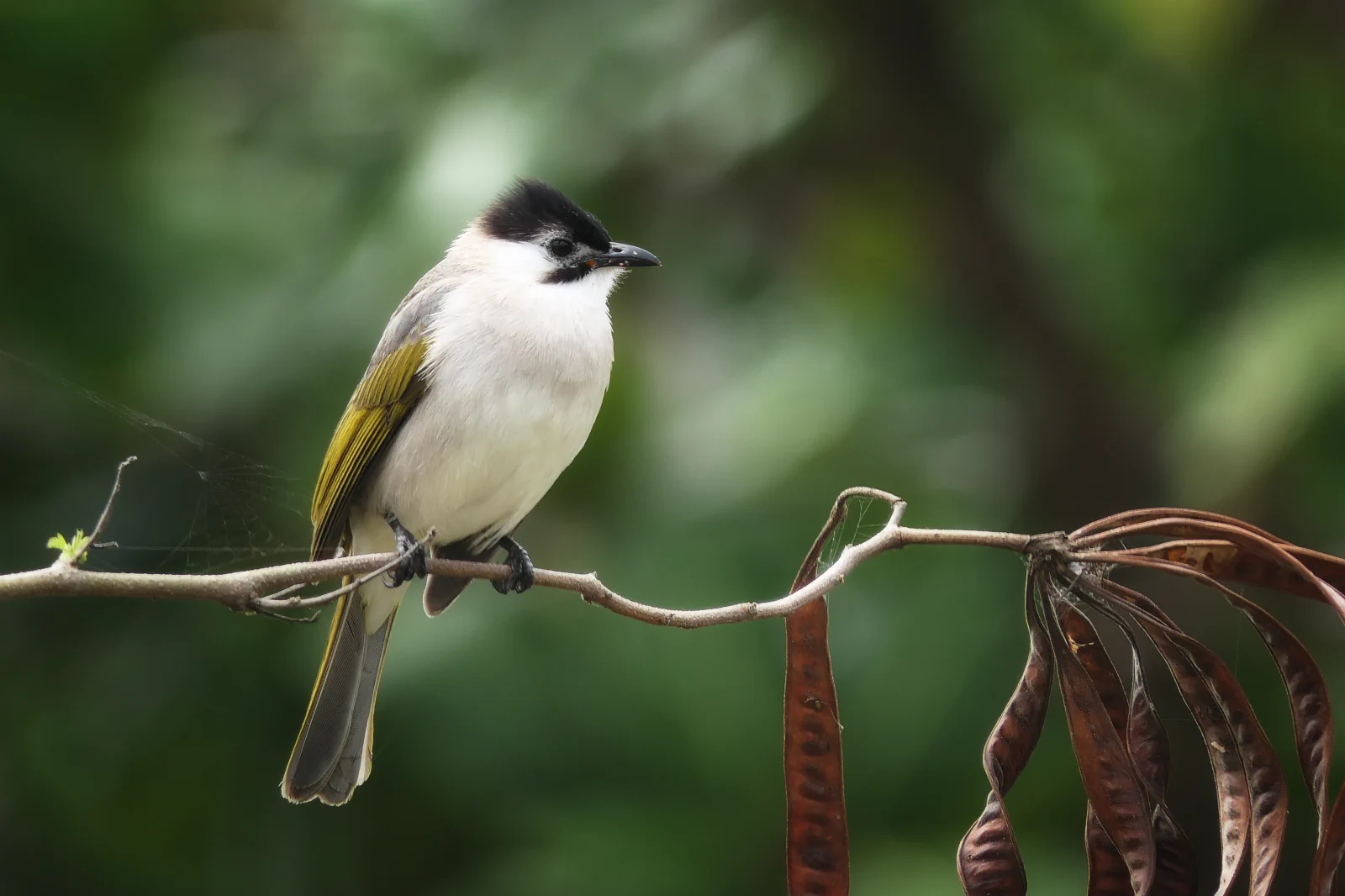
The Taiwan Bulbul (Pycnonotus taivanus), also known as Styan's Bulbul, is one of the most emblematic birds of Taiwan, yet it often goes unnoticed behind its far more common and widespread cousin, the Light-vented Bulbul (Pycnonotus sinensis), to which it is so closely related that it hybridises with it to the point of being threatened. With its jet-black cap, white facial mask, the discreet orange-red spot at the base of the lower mandible, and its olive-brown back, it has the look of a lively, cheerful passerine perched atop a bush or low tree. It is found wherever there is a forest edge, a hedgerow, a shaded garden, or secondary scrub along the villages of eastern and southern Taiwan, occupying a vantage point from which it watches for ripe fruit and flying insects.
But behind its compact silhouette lies a remarkably resourceful pycnonotid. The Taiwan Bulbul is not merely "the little black-headed bird of Hualien's gardens": it is an island endemic, sedentary, faithful to its territory, playful and vocal, whose survival is fraught with obstacles. To observe it is to discover the richness of a bird that defies human pressure while retaining all its wild, fragile and irreplaceable character.
Classification
The Taiwan Bulbul belongs to the family Pycnonotidae, which encompasses bulbuls, a group of species found mainly in Africa and tropical and subtropical Asia. It is placed in the genus Pycnonotus, one of the most diverse in the family with over 30 species. Described by Frederick William Styan in 1893, it is monotypic: no subspecies are recognised. It is a strict endemic of Taiwan, exclusively resident, with a range limited to the eastern and southern regions of the island. It is phylogenetically very close to the Light-vented Bulbul (Pycnonotus sinensis), with which it forms a sister-species pair whose ranges overlap locally.
Identification
The Taiwan Bulbul is a small to medium-sized passerine, stockier and shorter than a warbler or a leafbird. Its length is approximately 18 to 20 cm, with a wingspan of about 25 to 30 cm and a weight of roughly 30 to 40 grams.
The key identification feature is its entirely black cap, covering the crown and nape, contrasting sharply with the white feathers surrounding the eye. This facial pattern unambiguously distinguishes the Taiwan Bulbul from the Light-vented Bulbul, whose black cap gives way to a broad white patch on the nape. Another discreet but decisive feature is the small orange-red spot at the base of the lower mandible, often difficult to see in the field but consistent in adults.
Its back is olive-brown to grey-brown, with wings and tail darker brown, the edges of rectrices and remiges showing a yellowish-green border. The underparts are yellowish-white to cream, the flanks and thighs tinged with light grey-brown. The eyes are dark brown. The bill is entirely black, short and stout, typical of the genus. The legs are dark brown.
The sexes are similar. Juveniles are duller, with a less contrasting black cap, a paler bill, and overall plumage tending towards greyish-brown, lacking the crisp facial pattern of adults.
Hybrids with the Light-vented Bulbul show intermediate characters: they retain the black moustachial stripe and the periocular white feathers, but the white extends behind the crown, creating a recognisable mixed pattern.
Calls and song
The Taiwan Bulbul has a varied vocal repertoire, dominated by soft, melodious notes. Its most characteristic song is a sweet, upbeat phrase, often rendered as "pri tu rrilit", delivered from an exposed perch and repeated several times at regular intervals. It is a sound that carries pleasantly through gardens and forest edges in the morning.
Its contact call is a continuous chattering babble, produced by several individuals simultaneously, particularly when a group gathers around a fruiting tree. This collective hubbub can become quite intense at dawn, when bulbuls converge on fig trees and berry-laden bushes.
During territorial defence, it emits sharper, more accented notes punctuated by short, dry calls. These exchanges often accompany intimidation postures: bill pointed at the intruder, wings slightly spread, body held upright.
The young utter high-pitched, insistent calls, repeated "tchi-tchi-tchi", to solicit parents returning with fruit and insects.
Habitat
The Taiwan Bulbul favours warm, humid, semi-open habitats where dense shrub layers mingle with scattered trees. It is found in forest edges, secondary thickets, village gardens, urban parks, orchards, and hedgerows lining agricultural paths, from sea level up to approximately 600 to 800 metres in elevation.
Unlike the Light-vented Bulbul, which has largely adapted to dense urban environments and expanded across the north and west of the island, the Taiwan Bulbul prefers areas where natural vegetation retains some continuity: coastal valleys of the east, southern foothills, riverbanks and coastal cliffs. It particularly appreciates wild fruiting trees such as figs (Ficus spp.) and Calophyllum inophyllum (beautyleaf, or Indiapoon), in which it frequently nests.
It avoids closed primary forests at high altitude, barren areas, and intensive farmland devoid of hedgerows or copses. A shaded tropical garden, a secondary forest edge with fruiting figs, or a coastal valley planted with scattered trees can all constitute suitable habitat. Outside the breeding season, it becomes less territorial and may gather in small loose groups.
Behaviour
The Taiwan Bulbul is a lively, active, sociable, and noisy bird. It moves in quick hops through foliage, making short flights between trees, and spends much of its time perched atop a bush or low tree, surveying its surroundings.
During the breeding season, it lives in territorial pairs. The male defends his territory through song and brief aerial pursuits against intruding conspecifics. Courtship displays are more discreet than in other passerines: bowing, slow wing-fluttering, and the exchange of fruit beak-to-beak between partners.
Outside the breeding season, it becomes distinctly gregarious. Groups of 5 to 20 individuals may congregate around fruiting trees, sometimes mingling with the Light-vented Bulbul or other frugivorous species. These morning and evening gatherings can be quite noisy.
The Taiwan Bulbul is also known for its important ecological role as a seed disperser: by consuming whole fruits and voiding intact seeds, it actively contributes to the regeneration of local flora along forest edges and wastelands.
Movements
The flight of the Taiwan Bulbul is direct, fast, and undulating, generally over short distances between trees and bushes. Its wingbeats are rapid and jerky, with brief gliding phases. It does not practise hovering or sustained high-altitude flight.
It is a strictly sedentary species: it undertakes no migration. Seasonal movements are minimal, limited to local adjustments based on fruit availability. Juveniles may disperse modestly after fledging, but no migratory movement is documented.
Diet
The Taiwan Bulbul is essentially frugivorous. It feeds primarily on small fleshy fruits and berries: figs of Ficus spp., fruits of Macaranga, Trema, Melastoma, berries of Piper, and various edge-dwelling species. It swallows fruits whole and voids intact seeds, thus playing a key role in plant dispersal.
During the breeding season, it supplements its diet with invertebrates: flying insects caught in short sallies, caterpillars, spiders, and small arthropods gleaned from foliage. The young receive a mixed diet rich in insects to ensure rapid growth.
It forages at all levels, from understorey to low canopy, often in small groups moving from tree to tree. Its foraging technique involves methodically inspecting fruiting branches, plucking berries one by one, then moving to an open perch to consume them.
Breeding and nesting
Nesting takes place mainly from March to July, with a spring peak. A second clutch is common, and at least two broods per year are usual. The Taiwan Bulbul is discreetly territorial during breeding.
The female builds a compact cup nest of twigs, fine grass, roots and woven leaves, placed in a dense bush or low tree, generally between 0.8 and 5 metres above ground. A study conducted at Kenting showed that approximately 75% of nests were built in Calophyllum inophyllum, likely owing to the density of its protective foliage.
The female typically lays 3 to 4 eggs (averaging 3.3), pinkish or cream coloured, spotted with reddish-brown. Incubation lasts approximately 11 to 12 days, carried out mainly by the female. After hatching, the chicks are altricial: they remain in the nest for about 9 to 10 days before fledging. The male actively participates in feeding the chicks. The young stay with their parents for several weeks after fledging to learn to forage.
Distribution
The Taiwan Bulbul has a restricted and fragmented distribution, limited to the eastern and southern parts of the island of Taiwan. It is absent from the densely urbanised western plain, where the Light-vented Bulbul overwhelmingly dominates.
In the east, it is found along the coast between Hualien and Taitung, in the inland valleys of the Coastal Range, and as far south as Kenting National Park. It has disappeared from Yilan County in the northeast, where it has been replaced by the Light-vented Bulbul. The contact zone between the two species forms a narrow band where hybrids are frequent.
It is a strictly resident bird: no migratory population is known. Its island endemism makes it one of the symbols of Taiwan's avifauna, alongside the Taiwan Tit (Machlolophus holsti) and the Taiwan Whistling Thrush (Myophonus insularis).
Threats and conservation
The Taiwan Bulbul is classified as "Vulnerable" (VU) by the IUCN. Its decline is attributed to two main factors whose interaction is particularly concerning.
Habitat destruction and fragmentation caused by urbanisation, intensive agriculture, and tourism development reduce the area of forest edges and shrubby wastelands it depends on. The conversion of semi-natural areas into built land or monocultures progressively erodes its territory.
Hybridisation with the Light-vented Bulbul poses the most insidious threat. The two species, genetically very close, produce fertile hybrids where their ranges overlap. However, the Light-vented Bulbul is massively released into the wild during Buddhist religious animal-release ceremonies (fang sheng), causing the artificial expansion of its range and increasing contacts with the Taiwan Bulbul. Yilan County is the most tragic example: the Taiwan Bulbul has been entirely replaced there by hybrids or pure Light-vented Bulbuls.
Conservation of the Taiwan Bulbul requires preserving forest-edge corridors in the east and south of the island, strictly managing animal releases during religious ceremonies, monitoring the genetics of populations to detect hybridisation zones, and creating nature reserves that include semi-open habitats rather than only primary forest. Raising awareness among religious communities about the consequences of fang sheng and proposing alternative practices of animal compassion: these are all measures that favour this endemic species. The Taiwan Bulbul has also been listed as a protected species of Class II in Taiwan since 2021.
Going further
Observing a Taiwan Bulbul means capturing one of the most endearing scenes in the coastal valleys of eastern Taiwan. Unlike the Light-vented Bulbul that haunts urban parks and the streets of Taipei, it remains faithful to wild edges, fig trees along Hualien's trails, and Kenting's hedgerows. But once it gathers around a fruiting tree, it reveals an intense social behaviour: collective babbling, beak-to-beak berry exchanges, playful pursuits through the foliage.
It embodies the challenge of island endemic species: the fragile balance between adaptation and isolation, where the pressure of an invasive sibling species and human practices can overturn millennia of evolution in mere decades. Wherever it nests, there are preserved edges, wild fruiting trees, relative tranquillity, and the freedom that allows bulbuls to thrive.
Behind its black cap, white mask, and discreet orange spot, the Taiwan Bulbul remains a bird of contrasts (locally common yet globally vulnerable, familiar with gardens yet threatened in its genetic integrity, endemic yet invaded), whose presence reminds us that island species deserve particular vigilance and that the ordinary biodiversity of an island sometimes hides unique, world-one-of-a-kind treasures.