

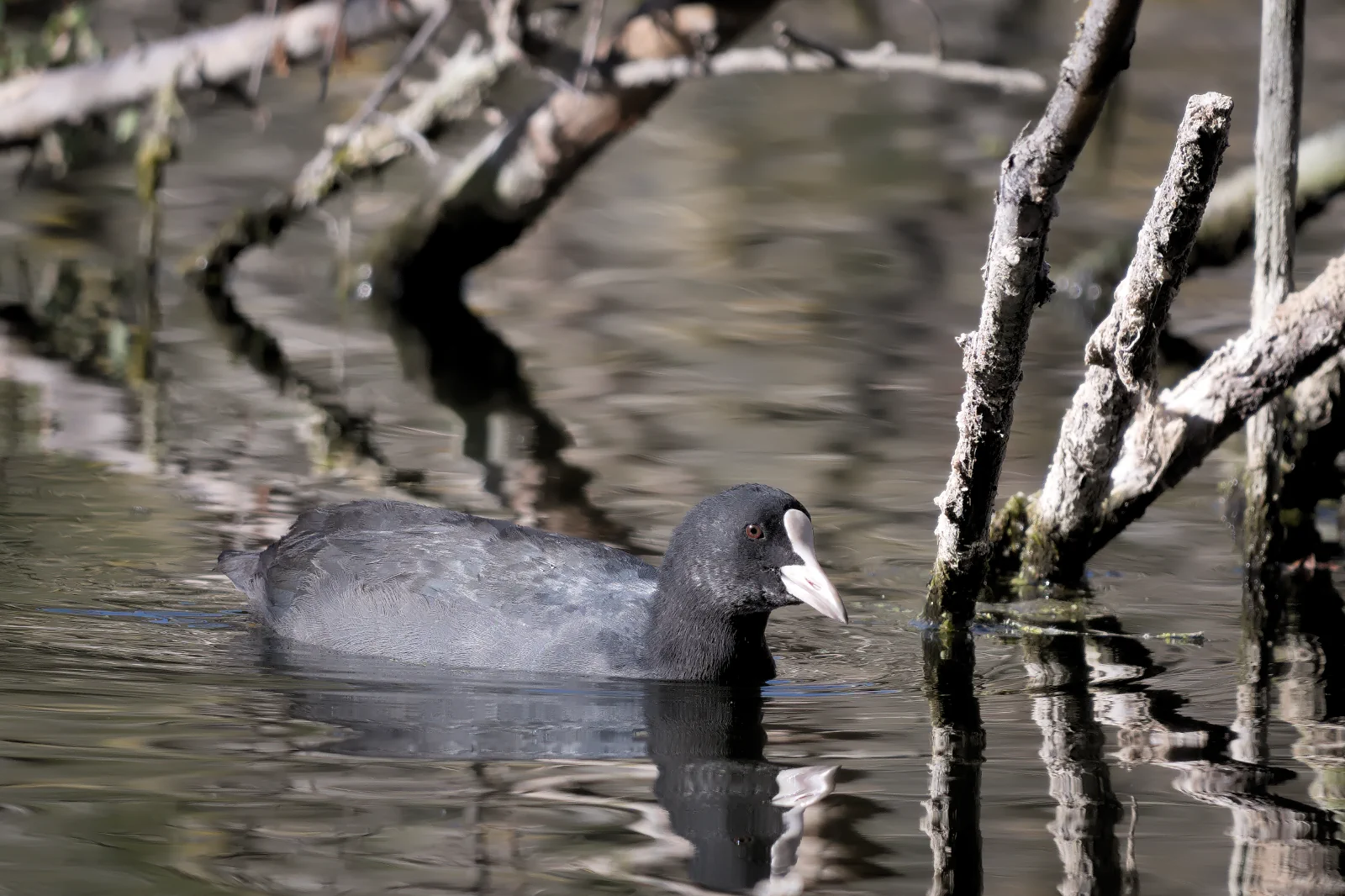
The Eurasian Coot (Fulica atra) is one of the most familiar aquatic birds of our ponds and lakes, and one of the most easily recognised. With its deep black plumage, striking white bill and characteristic frontal shield, it resembles a small grebe that never goes unnoticed on the water. It can be seen on the surface whenever there is calm water, pecking at aquatic plants, diving briefly, or swimming with that distinctive gait that makes its entire body vibrate.
But behind its familiar silhouette hides a resourceful rallid. The Eurasian Coot is not just "the black bird with a white bill from the ponds": it is an adaptable species, social at times, territorial at others, an excellent diver and attentive parent. Observing it means discovering the richness of a bird that dominates calm waters while retaining its wild nature.
Classification
- Order: Gruiformes
- Family: Rallidae
- Genus: Fulica
- Species: Fulica atra
The Eurasian Coot belongs to the Rallidae family, which includes coots, gallinules, moorhens and crakes. It is the best-known and most widespread of European coots. It is a herbivorous and opportunistic omnivore, closely associated with aquatic habitats rich in vegetation: lakes, ponds, marshes, reservoirs, river mouths. Several subspecies are recognised across its Eurasian range.
Identification
The Eurasian Coot is a medium-sized aquatic bird, the size of a female duck or slightly smaller, stocky and rounded, with a characteristic rounded silhouette. Its length is approximately 34 to 43 cm, with a wingspan of 56 to 70 cm.
The main identification criterion is certainly its deep black, almost uniform plumage, which contrasts strongly with its white bill and white frontal shield (a bony plate located above the bill that gives the bird a very recognisable face). This frontal shield is more developed in males than in females.
The rest of the plumage is subdued: dark grey above, paler below, with bluish iridescence in good light. The eyes are bright red, adding to its unusual appearance. The legs are greyish, with lobed toes (like flaps) that allow it to swim efficiently and even run briefly on water during displays.
The female is slightly smaller than the male, with a less developed frontal shield. Young birds have grey-brown plumage, less contrasted, with a less white bill and no frontal shield or one that is very reduced. They resemble a dull version of adults but retain the characteristic red eyes.
Songs and Calls
The Eurasian Coot possesses a varied vocal repertoire, dominated by harsh and powerful calls. Its most characteristic cry is a dry, loud "kwak", emitted regularly during movements or as a warning signal. It is a sound that carries far over water, typical of frequented wetlands.
During display or territorial defence, the male emits a more guttural call, a kind of low, continuous "krark". These vocal exchanges often accompany aggressive postures: head held high, half-spread wings, bill pointed at the opponent.
Young birds emit high-pitched, insistent cries, repeated "pipipipi", to solicit parents seeking food. These calls can become very intense when the brood demands feeding.
Territorial calling is rarely melodious, but it fulfils its function: marking space, alerting competitors, coordinating family movements.
Habitat
The Eurasian Coot favours stagnant or slow-moving freshwaters rich in aquatic vegetation. It can be found on large lakes, ponds, reservoirs, marshes, flooded areas, river mouths, coastal lagoons, canals and even urban artificial basins.
It needs sufficient vegetation cover for feeding and nesting: reeds, cattails, pondweeds, water lilies, floating algae. An open space for swimming and taking off is also essential, as the Eurasian Coot requires a good expanse of water to take flight.
It avoids completely open habitats without vegetation, overly turbulent or polluted waters, and urbanised areas without access to open water. A pond with vegetated margins, a lake with reedbeds, a managed wetland can constitute suitable territory.
In winter, it frequents open water bodies assiduously, even in urban environments, where it can form large flocks.
Behaviour
The Eurasian Coot is a lively, active, often noisy bird. It moves on water with characteristic swimming, body slightly tilted, lobed feet propelling water in a rhythmic fashion. It can also walk on emergent aquatic plants, or run on water for a few metres during displays.
It is a highly social species outside the nesting period. In autumn and winter, it gathers in large flocks, sometimes several hundred individuals on the same water body. These gatherings are noisy and busy, with constant flights from one area to another.
During nesting, it becomes territorial. The pair vigorously defends its sector around the nest, chases intruders and engages in confrontations with neighbours. These encounters can be spectacular: chases on water, bill strikes, spread wings, incessant calls.
The Eurasian Coot is also known for its "water running" behaviour (rapid sprint across the surface before take-off, necessary as it can only fly from a large open expanse). It is an impressive spectacle when several individuals take flight simultaneously.
Flight
The Eurasian Coot's flight is fast, direct and sustained. Once launched after its water run, it beats its wings rapidly and maintains straight, efficient flight at moderate height above water or vegetation.
Take-off is the most labourious moment: the Coot must run a long distance beating its wings, raising water behind it before rising. It is a typical sight on frequented water bodies (one hears first the sound of feet hitting the surface, then rapid wingbeats).
During migration, its flight becomes higher and more sustained, often nocturnal. That is why the Eurasian Coot is rarely observed during active migration: it is discovered resting at stopover sites in wetlands.
Feeding
The Eurasian Coot is essentially herbivorous, but it diversifies its diet according to the season. It feeds mainly on aquatic plants: reed leaves, cattail stems, water lilies, algae, hydrophyte seeds.
During the breeding period, it supplements its diet with invertebrates: aquatic insects, larvae, small molluscs, crustaceans, worms. Young birds also receive animal prey to ensure rapid growth.
It searches for food at the surface (grazing), by diving briefly to grasp submerged plants, or by walking in shallow areas. Its diving technique is characteristic: it submerges head-first, keeping part of its body visible, then surfaces with the grasped plant.
At artificial feeders, it readily accepts offered food: bread, grain, vegetables. But these additions can upset its natural diet and encourage excessive concentrations.
Breeding and Nesting
Nesting begins in spring, often as early as March or April depending on latitude and local conditions. The pair builds a floating or semi-floating nest, anchored in dense vegetation. It is a bulky platform made of reed stems, dead leaves and various plant materials, with a central cup lined with finer fibres.
The nest is often situated in reeds, a few metres from the edge, well hidden but accessible by water. The female typically lays 5 to 9 eggs, sometimes more in a second clutch. Incubation lasts approximately 21 to 23 days, performed alternately by both parents.
After hatching, the young are precocial: they leave the nest almost immediately and follow the parents on water. Both parents actively participate in feeding and protecting them for several weeks. Young remain with their parents until the complete juvenile moult, approximately two to three months.
A second clutch is frequent if the first succeeds or fails early. The Eurasian Coot can therefore raise two broods in the same season under favourable conditions.
Distribution
The Eurasian Coot has an extremely vast distribution, covering almost all of Eurasia, from western Europe to the Russian Far East, from Scandinavia to the subtropical regions of Africa and Asia. It is absent from extreme deserts and the harshest polar regions.
In Europe, it is present everywhere, from Nordic countries to Mediterranean islands. It is common throughout French territory, from Alpine lakes to Landes ponds, via Breton marshes and Camargue ornithological reserves.
Some populations are sedentary, especially in temperate oceanic regions where waters do not freeze. Others are migratory, coming from the north in winter to spend it in milder areas. In France, it is thus both a summer breeder, winter visitor and passage migrant depending on regions and years.
Threats and Protection
The Eurasian Coot remains a common and widely distributed species. However, it depends on the availability of appropriate aquatic habitats and water quality.
Wetland drainage, pond drying, shoreline development, water pollution and agricultural intensification reduce available areas for nesting and feeding. Human disturbance, particularly through boating activities and tourist visitation, can disrupt reproduction.
Predation by cats, foxes and other carnivorous mammals affects nests and young on the ground or nearby. Collisions with electric cables, windows or vehicles are occasionally observed, particularly during take-offs and landings.
Protection of the Eurasian Coot involves preserving functional wetlands, limiting pollution, maintaining diverse aquatic vegetation and managing human visitation reasonably. Creating buffer zones around water bodies, regulating fishing and boating activities, preserving reedbeds: all actions that favour this emblematic species.
Further Reading
Observing an Eurasian Coot means witnessing one of the most classic scenes of French wetlands. It does not really hide: it can be seen from the bank, from a trail, from a boat. But behind this apparent familiarity hides a complex bird, with its territories, nesting strategies, complex social relationships.
It embodies ordinary aquatic life: that fragile balance between water and land, where plants dominate and life flourishes on condition that we preserve it. Where it thrives, there are calm waters, abundant vegetation, relative tranquility and that freedom that allows waterbirds to prosper.
Behind its black plumage, white bill and red eyes, the Eurasian Coot remains a bird of contrasts (social but territorial, familiar but wild, common but vulnerable), whose regular presence reminds us that wetlands deserve particular vigilance and that ordinary biodiversity merits as much attention as the rarest species.