

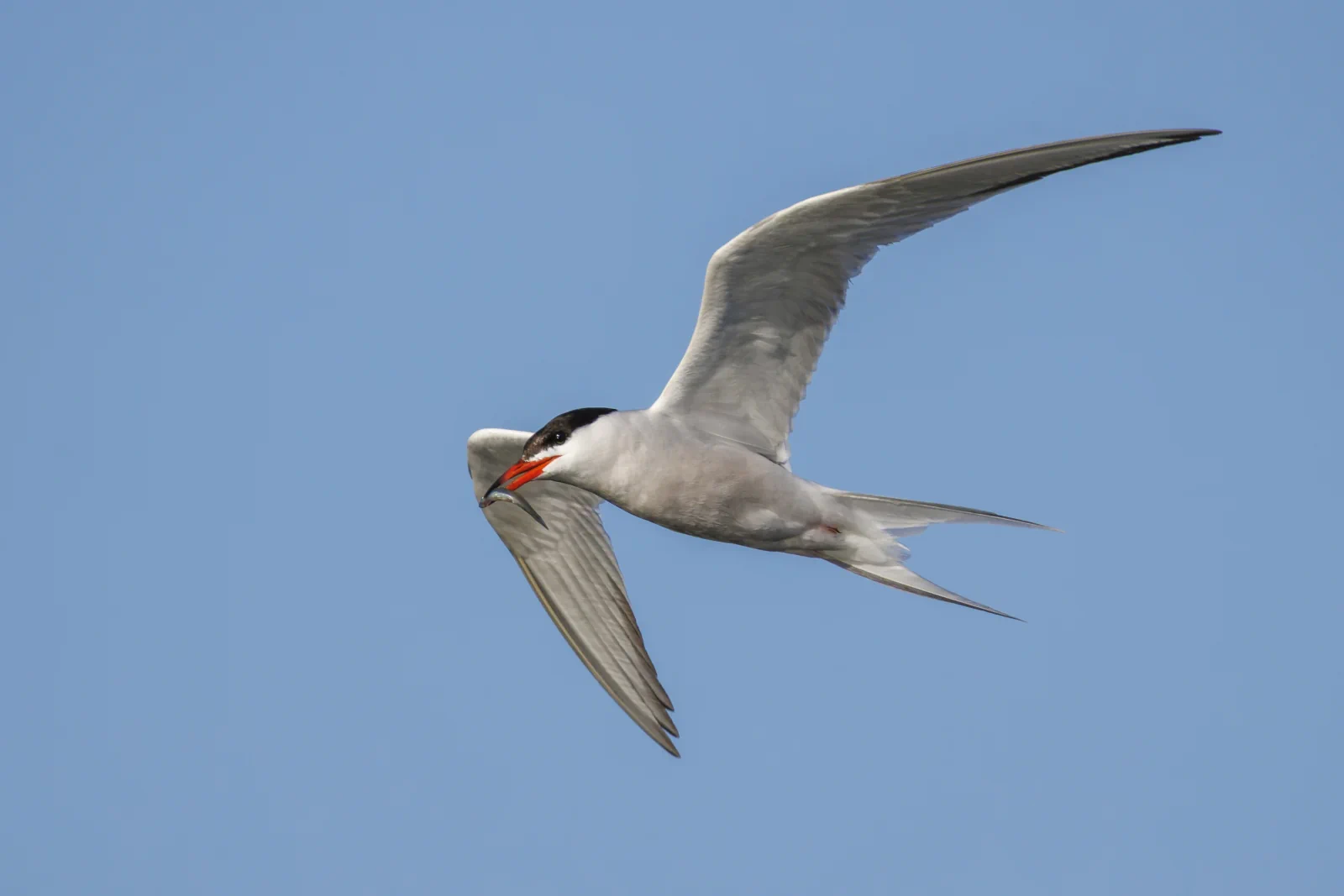
The Common Tern is one of the most familiar seabirds of our coastlines and inland waters, yet it often goes unnoticed behind its larger cousin, the Caspian Tern, or is mistaken for the Arctic Tern, which it closely resembles. With its pearl-grey plumage, black cap, bright orange-red bill with a black tip, and deeply forked tail, it has the look of an elegant little sailplane skimming above the waves. It is found wherever there is a fish-rich stretch of water — coastline, estuary, lake, broad river, or flooded gravel pit — hovering over the surface, freezing in mid-air, then plunging abruptly to seize a fish.
But behind its slender silhouette lies a remarkably resourceful tern. The Common Tern is not merely "the red-billed sea swallow of the coast" : it is an extraordinary migrant, colonial, noisy at the breeding ground, tireless in flight, and an excellent diver. Watching it means discovering the richness of a bird that masters both air and water while retaining all its wild nature.
Classification
The Common Tern belongs to the family Laridae (subfamily Sterninae), which includes terns, marsh terns, and noddies. It is one of the most widespread and best-known species of the Northern Hemisphere, occurring across Eurasia and North America. It is a piscivorous bird strictly tied to open aquatic environments : marine coasts, estuaries, lakes, rivers, gravel pits, and reservoirs. Several subspecies are recognised across its vast circumpolar range.
Identification
The Common Tern is a medium-sized seabird, smaller and more slender than a gull. Its length is approximately 31 to 35 cm, with a wingspan of 77 to 98 cm and a weight of 110 to 140 grams.
The key identification feature is its bright orange-red bill with a black tip, combined with its black cap extending to the nape. These vivid contrasts stand out against its light pearl-grey upperparts and white underparts. The upperwings are grey, with darker outer primaries forming a clear contrast with the pale leading edge. Its tail is deeply forked, a distinctive trait visible both in flight and at rest.
Its eyes are dark brown. Its legs are orange-red, short, and webbed. In flight, a dark carpal bar is visible on the upperwing, along with a dark trailing edge on the outer primaries.
In non-breeding (winter) plumage, the forehead turns white, the black cap shrinks and becomes streaked with white, and the bill darkens to blackish at the base. Juveniles have a markedly different appearance : scaly brown back, incomplete black cap, blackish bill, dull orange legs, and wings bearing dark markings forming a characteristic diagonal "saddle."
Calls and songs
The Common Tern possesses a varied vocal repertoire dominated by piercing, strident calls. Its most characteristic call is a sharp, loud "kik" or "ki-rrrk," uttered in flight or as an alarm signal. It carries far across the water and over noisy colonies.
During courtship or territorial defence, it utters a descending, guttural "kee-errr," a prolonged harsh cry. These vocal exchanges often accompany confrontational postures : bill pointed at the intruder, wings half-open, body leaning forward.
Chicks give high-pitched, insistent "tchi-tchi-tchi" calls to solicit food from foraging parents. These calls can become intensely loud when the entire brood demands feeding in a deafening chorus.
When threatened on the nest, it can emit a shrill alarm call and dive-bomb the intruder, sometimes ejecting droppings to display aggression.
Habitat
The Common Tern favours open stretches of water, still or moderately flowing, rich in fish. It is found on marine coastlines (sandy beaches, rocky islets, coastal lagoons) but also inland : natural lakes, flooded gravel pits, reservoirs, broad rivers, and calm streams.
Unlike the Little Tern, which prefers shallow wetlands and mudflats, the Common Tern favours open water sufficiently deep for plunge-diving, with sparsely vegetated nesting sites : gravel islands, sandbanks, flat beaches, and occasionally urban flat roofs. It requires bare or lightly vegetated substrates for nesting, in order to detect predators at a distance.
It avoids closed, wooded habitats, overly turbid or rough waters, and fish-poor areas. A gravel island in the middle of a lake, a sheltered flat beach, or an abandoned gravel pit can constitute suitable habitat. In colonies, nests may be spaced only a few metres apart.
On migration and in winter, it frequents tropical and subtropical coasts, estuaries, mangroves, and large lakes in Africa, South America, and Australasia.
Behaviour
The Common Tern is an active, lively, gregarious, and often noisy bird. It moves in flight with quick, supple wingbeats, gliding briefly before hovering motionless over a potential prey item. This is a characteristic hunting behaviour observable from afar.
It is a colonial species throughout the breeding season. Colonies can range from a few dozen to several thousand pairs depending on the site. These gatherings provide collective protection against predators : crows, gulls, foxes, rats. At the approach of an intruder, the whole colony rises in a clamour, forming a cloud of aggressive birds.
Outside the breeding season, it becomes less territorial but remains gregarious. During migration, loose groups can be seen resting on sandbanks or buoys, sometimes mixed with other tern species or gulls.
The Common Tern is also known for its elaborate aerial displays : pairs perform synchronous flights, vertical climbs, dives, and in-flight fish offerings, where the male presents a prey item to the female bill to bill.
Flight
The Common Tern's flight is light, fast, and agile, most often conducted low over the water. Its wingbeats are sustained and supple, with brief gliding phases. It can hover motionless facing the wind, wings beating, to spot prey beneath the surface.
The plunge is spectacular : after hovering for a few seconds, it closes its wings and dives almost vertically, entering the water feet-first, then surfaces quickly with a fish in its bill.
On migration, its flight becomes higher and more sustained, often nocturnal. This is why the Common Tern is rarely observed in active migration : it is discovered at rest, at migratory stopovers, on sandbanks or coastal roosts.
Feeding
The Common Tern is primarily piscivorous. It feeds mainly on small surface and mid-water fish : sprats, sandeels, sticklebacks, juvenile herrings, dace, roach, and small salmonids in freshwater.
During the breeding season, it complements its diet with invertebrates : flying insects caught in the air, crustaceans, molluscs, and marine worms. Chicks receive exclusively animal prey, especially whole fish, to ensure rapid growth.
It hunts by flying over the water at 2 to 10 metres height, hovering, then plunging sharply. Its diving technique is characteristic : it sometimes submerges entirely, leaving only the wing tips visible for an instant, then resurfaces with the fish held crosswise in its bill, sometimes after several successive attempts.
Breeding and nesting
Nesting begins in spring, often as early as April or May depending on latitude and local conditions. The Common Tern nests in colonies, sometimes mixed with other terns or gulls. The pair builds a ground nest in a shallow depression, lined with gravel, shell fragments, twigs, or plant debris.
The nest is often situated on a gravel island, a flat beach, or a bare sandbank, occasionally on an urban flat roof. The female generally lays 2 to 3 eggs (sometimes 4), cream or olive-coloured spotted with dark brown-black. Incubation lasts approximately 21 to 22 days, carried out by both parents in turn.
After hatching, the chicks are precocial : they leave the nest within a few days and hide in low vegetation or surrounding debris. Both parents actively feed and protect them for several weeks. The young remain dependent on their parents until fledging, approximately 22 to 28 days after hatching, then stay with the adults for several more weeks to learn to fish.
A second clutch is possible if the first fails early. The Common Tern generally raises only one brood per season in our latitudes.
Distribution
The Common Tern has an extremely vast range, covering the entire Northern Hemisphere : Europe, Asia, and North America. It is absent from equatorial regions for breeding, but returns to winter in tropical and southern zones.
In Europe, it is present everywhere as a breeding bird, from Icelandic coasts to Mediterranean marshes. It is common throughout mainland France, from the Normandy cliffs to the Landes ponds, via the Loire islets, the Sologne gravel pits, and the Camargue ornithological reserves.
It is a great migrant : northern and continental populations move south in autumn, crossing the tropics to winter along the coasts of West Africa, South America, and sometimes as far as Australia. In France, it is therefore a summer breeder and passage migrant depending on the region ; it can be observed on passage across the whole country from April to October.
Threats and conservation
The Common Tern remains a common and widely distributed species, classified as "Least Concern" (LC) by the IUCN. However, it depends on the availability of open nesting sites and the fish richness of the waters it exploits.
Coastal development, beach erosion, destruction of islets by floods and storms, spontaneous vegetation invading gravel pits, and tourist activity on beaches reduce the available nesting area. Predation by rats, foxes, crows, and gulls affects eggs and chicks. Water pollution, overfishing, and collisions with wind turbines or power lines constitute additional threats.
Protection of the Common Tern relies on preserving nesting sites : maintaining gravel islands, managing vegetation on colonies, installing artificial floating rafts, restricting human access during breeding, and controlling invasive predators. Creating coastal reserves, raising public awareness, and fitting power lines with deterrents : these are all measures that favour this species.
Going further
Watching a Common Tern means grasping one of the most dynamic scenes of the coastline and inland waters. Unlike the gull, which patrols in slow flight, it hunts by diving, freezing in a hover above the wave before plunging into it in a flash. But as soon as it settles at the colony, it reveals intense social behaviour : synchronous displays, fish offerings, collective defence of the territory.
It embodies the aerial life of open waters : that fragile balance between sky and surface, where fish shoals attract hunters and where life thrives provided it is preserved. Where it nests, there are fish-rich waters, open islets, relative tranquillity, and that freedom which allows terns to flourish.
Behind its grey plumage, black cap, and red bill, the Common Tern remains a bird of contrasts (graceful yet aggressive at the nest, familiar yet long-distance migrant, common yet vulnerable), whose summer presence reminds us that wetlands and coastlines deserve special vigilance, and that ordinary biodiversity deserves as much attention as the rarest species.