

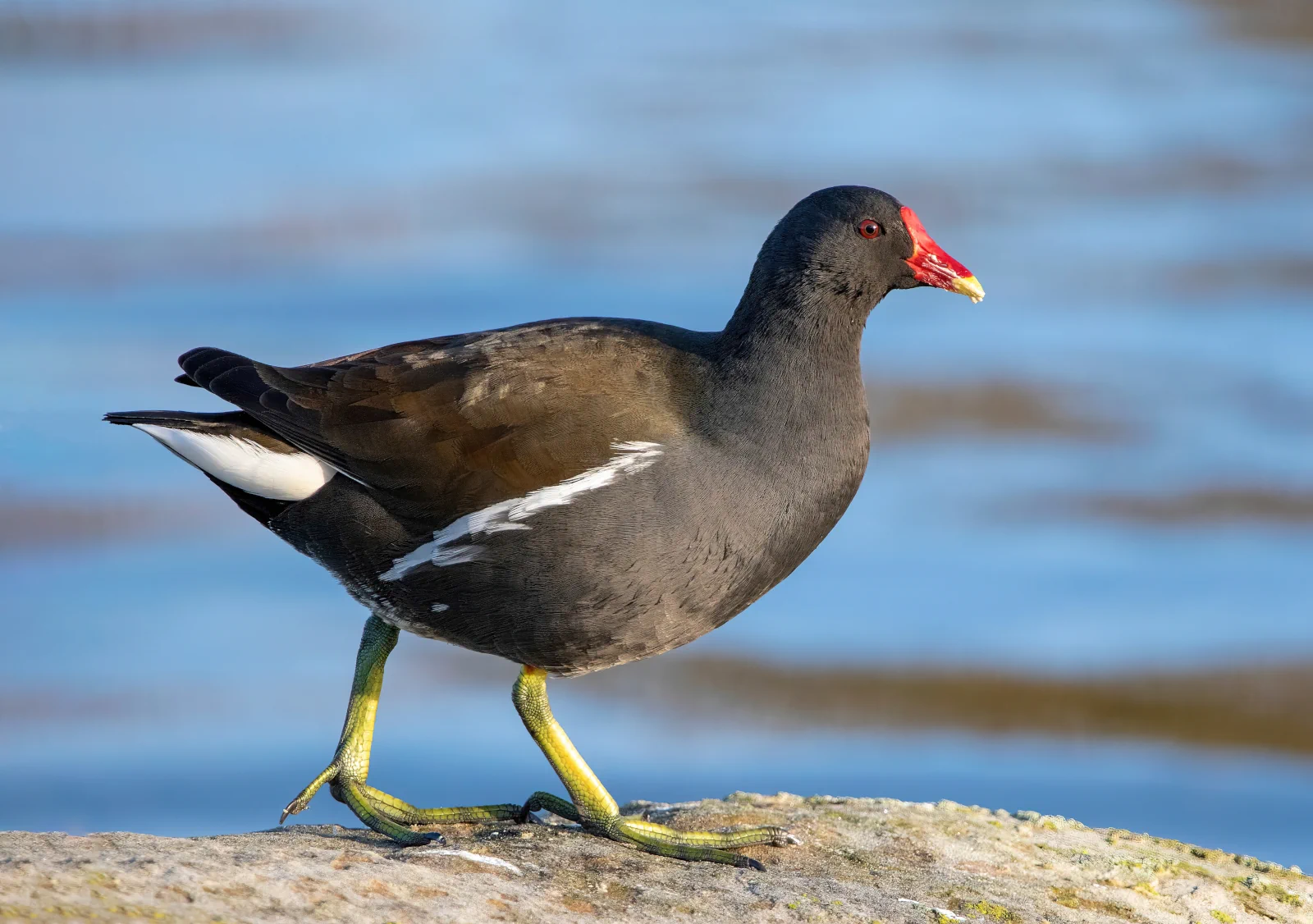
The Common Moorhen is one of the most familiar aquatic birds of our ponds and quiet waterways, yet it often goes unnoticed behind its more conspicuous cousin, the Eurasian Coot. With its slate-grey plumage, bright red frontal shield and red bill with a yellow tip, it has the look of an elegant little hen that slips between the reeds. It can be found wherever there is a sheet of freshwater bordered by vegetation, pecking at aquatic plants, swimming with its tail cocked, or vanishing suddenly into the reed beds.
But behind its discreet silhouette lies a resourceful rallid. The Common Moorhen is not merely "the grey bird with the red bill of the ponds": it is an adaptable, agile species — sometimes territorial, sometimes sociable — an excellent swimmer and an attentive parent. Watching it reveals the richness of a bird that navigates aquatic vegetation with mastery while retaining all its wild character.
Classification
The Common Moorhen belongs to the family Rallidae, which includes coots, gallinules, moorhens and rails. It is one of the most widespread and well-known species of wetlands across Eurasia, Africa, and the Americas. It is an opportunistic omnivore, closely tied to aquatic environments rich in emergent vegetation: marshes, ponds, canals, slow rivers, reservoirs and even urban water features. Several subspecies are recognised across its vast range.
Identification
The Common Moorhen is a medium-sized aquatic bird, roughly the size of a small duck, more slender than the Eurasian Coot. Its length is approximately 30 to 38 cm, with a wingspan of 50 to 55 cm and a weight of 190 to 490 grams.
The key identification feature is its bright red frontal shield (a bony plate above the bill) and its red bill with a yellow tip. These vivid colours contrast with its dark slate-grey plumage, tinged with brown-black. A distinctive white line runs along the flanks, and the undertail coverts show two prominent white patches, especially visible when the bird raises its tail while swimming — a characteristic behaviour of the species.
Its eyes are bright red. The legs are long, green or yellowish, with very long, unwebbed toes (but equipped with skin lobes), enabling it to walk on floating plants and swim efficiently.
The female is slightly smaller than the male, with a less developed frontal shield. Juveniles are grey-brown, less contrasting, lacking the red shield and the white flank line. Their bill is darker. They resemble a drab version of the adults.
Calls and Vocalisations
The Common Moorhen possesses a varied vocal repertoire dominated by harsh, guttural calls. Its most characteristic call is a dry "krek" or "gek", uttered regularly during movements or as an alarm signal. It is a sound that carries over water and reed beds.
During courtship or territorial defence, it produces a deeper, continuous call — a sort of grunt or dull neigh. These vocal exchanges often accompany confrontation postures: head raised, wings half-open, bill pointed at the opponent.
Chicks emit high-pitched, insistent "pipipipi" calls to solicit food from their parents. These calls can become very intense when the brood is hungry.
When threatened, it may give a sharp whistle or a piercing alarm call, accompanied by nervous head-bobbing.
Habitat
The Common Moorhen favours still or slow-moving fresh waters, rich in emergent vegetation. It is found in marshes, ponds, lakes, canals, ditches, calm rivers, reservoirs, flooded areas and even urban park basins.
Unlike the Eurasian Coot, which appreciates open water, the Moorhen prefers thick borders of reeds, cattails, water lilies and riparian vegetation where it can conceal itself. It requires sufficient plant cover for feeding, nesting and protection from predators.
It avoids entirely open environments without vegetation, saltwater or overly turbulent waters, and built-up areas without access to open water. A pond with vegetated margins, a canal lined with reeds, or a pond with cattails can all constitute suitable territory. A minimum territory of about 20 m² is generally required.
In winter, it frequents open water bodies and coastal wetlands, where it may form loose small groups.
Behaviour
The Common Moorhen is a lively, active bird — sometimes noisy but often discreet. It moves on water with a characteristic swimming style, body slightly tilted, tail raised to expose its white patches. It can also walk on floating aquatic plants thanks to its long toes, or dive briefly to escape danger.
It is a sociable species outside the breeding season. In autumn and winter, it can form small groups, sometimes a few dozen individuals on a single water body. These gatherings are more discreet than those of the Eurasian Coot.
During breeding, it becomes territorial. The pair vigorously defends its nesting area, chasing intruders and engaging in confrontations with neighbours. These disputes can be spectacular: pursuits on water or through reeds, pecking, wings spread, incessant calling.
The Moorhen is also known for its ability to run on lily pads and floating plants — a charming and characteristic sight on summer ponds.
Flight
The Common Moorhen's flight is fast, direct and generally low, performed just above vegetation or water. Once launched after its run across water or plants, it beats its wings rapidly and maintains a straight, efficient course.
Take-off is laborious: the Moorhen must run a certain distance flapping its wings before becoming airborne. It is a typical sight at frequented wetlands, though less spectacular than the Coot's.
During migration, its flight becomes higher and more sustained, often nocturnal. This is why the Moorhen is rarely observed in active migration: it is discovered at rest, at migratory stopovers, in wetland resting sites.
Diet
The Common Moorhen is omnivorous. It feeds primarily on aquatic vegetation: leaves, stems and seeds of reeds, duckweed, submerged plant beds and bankside grasses.
During the breeding season, it supplements its diet with invertebrates: aquatic insects, larvae, molluscs, worms, slugs, spiders. Chicks also receive animal prey to ensure rapid growth. It may occasionally consume tadpoles, fish eggs or small amphibians.
It forages by walking on emergent plants, swimming, or brief diving. Its diving technique is characteristic: it plunges head-first, keeping part of its body visible, then surfaces with the plant or prey seized.
Reproduction and Nesting
Nesting begins in spring, often as early as March or April depending on latitude and local conditions. The pair builds a floating or semi-floating nest, anchored in dense vegetation. It is a platform made of reed stems, dead leaves and various plant materials, with a central cup lined with finer fibres.
The nest is typically situated in reeds or bushes near water, well concealed but accessible by both land and water. The female generally lays 6 to 12 eggs, cream-coloured with brown spotting. Incubation lasts approximately 21 to 23 days, shared by both parents in alternation.
After hatching, chicks are precocial: they leave the nest almost immediately and follow their parents on the water. Both parents actively participate in feeding and protecting them for several weeks. Young remain with their parents until independence, approximately 6 to 8 weeks.
A second clutch is common if the first succeeds or fails early. The Common Moorhen can therefore raise two broods in a single season under favourable conditions.
Distribution
The Common Moorhen has an extremely vast distribution, covering nearly every continent: Europe, Asia, Africa, North America and South America. It is absent from extreme deserts, polar regions and certain isolated oceanic islands.
In Europe, it is present everywhere, from Nordic countries to Mediterranean islands. It is common across the entire French territory, from Alpine lakes to Landes ponds, Breton marshes and Camargue reserves.
Some populations are resident, particularly in temperate oceanic regions where waters do not freeze. Others are migratory, moving south in winter to milder zones. In France, it is simultaneously a resident breeder, summer breeder and winter visitor depending on the region.
Threats and Conservation
The Common Moorhen remains a common and widely distributed species, classified as "Least Concern" (LC) by the IUCN. However, it depends on the availability of suitable aquatic habitats and water quality.
Wetland drainage, pond drying, bankside urbanisation, water pollution and agricultural intensification reduce the available surface for nesting and feeding. Human disturbance, particularly from water sports and tourism, can disrupt breeding. Predation by cats, rats, foxes and other mammalian carnivores affects nests and young.
Conservation of the Moorhen relies on preserving functional wetlands, reducing pollution, maintaining diverse aquatic vegetation and managing human access sensibly. Creating buffer zones around water bodies, protecting reed beds and restricting predator access to nesting sites: all measures that benefit this species.
Further Reflections
Watching a Common Moorhen means capturing one of the most intimate scenes of wetland life. Unlike the Coot which exposes itself on open water, it often hides in vegetation, revealing only its grey back or the red flash of its frontal shield. But once it feels safe, it displays fascinating behaviour: running across lily pads, acrobatic dives, attentive care of its young.
It embodies discreet aquatic life: that fragile balance between water and land, where plants dominate and life teems, provided it is preserved. Where the Moorhen thrives, there are calm waters, abundant vegetation, relative tranquillity and the freedom that allows waterbirds to prosper.
Behind its grey plumage, red shield and green legs, the Common Moorhen remains a bird of contrasts (discreet yet territorial, familiar yet wild, common yet vulnerable), whose regular presence reminds us that wetlands deserve particular vigilance and that ordinary biodiversity merits as much attention as the rarest species.