

The Common Chiffchaff (Phylloscopus collybita) is one of the smallest passerines observable in our woodlands, gardens, and forests. With its discreet silhouette, dull olive-brown plumage, and constantly active behavior, this bird is difficult to approach but its characteristic song regularly reveals its presence. This small insectivorous migrant is one of the first signs of spring's return in our temperate zones.
Behind its apparent discretion lies a survival expert. The Common Chiffchaff is not simply « the little green bird singing phill-bee »: it is a remarkably adapted species, tireless in its food search, skilled at camouflage, and resilient to climatic variations. Observing it carefully means entering the fascinating world of an essential link in the forest food chain.
Taxonomy
Order: Passeriformes
Family: Phylloscopidae
Genus: Phylloscopus
Species: Phylloscopus collybita
The Common Chiffchaff belongs to the Phylloscopidae family, which includes leaf warblers, small insectivorous passerines mainly distributed across the northern hemisphere. It is one of the most common leaf warbler species in Europe. Several subspecies exist throughout its Eurasian range, with slight morphological and vocal variations.
Identification
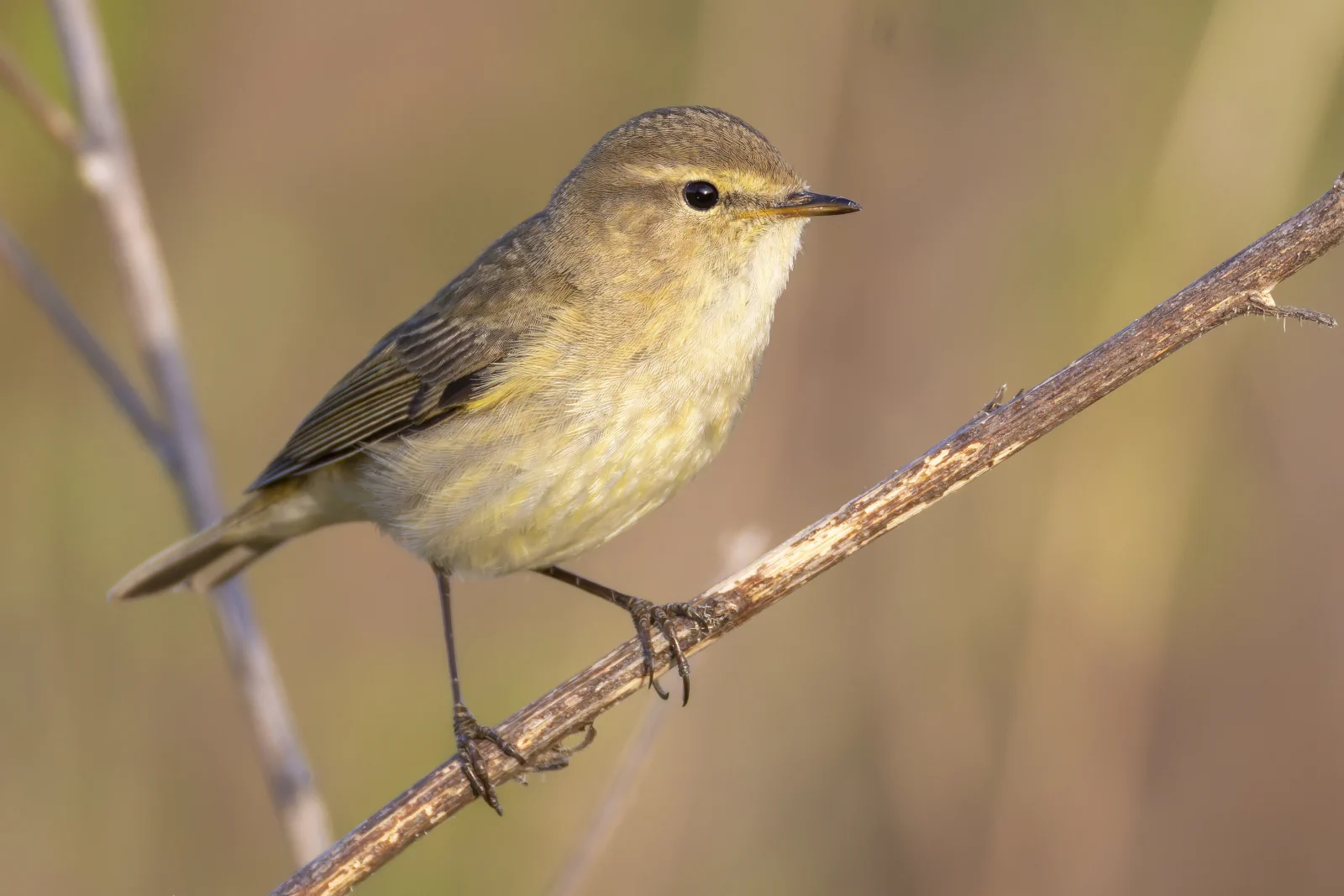
The Common Chiffchaff measures approximately 11 to 12.5 cm in length with a wingspan of 18 to 22 cm. It typically weighs between 6 and 13 grams.
Its plumage is subdued and camouflaged: dull olive-brown above, yellowish-white below sometimes with a grayish tint on the breast. This coloration allows it to blend perfectly into foliage.
The main identification criterion lies in its head: a prominent pale supercilium (whitish or yellowish) well-marked above the eye, contrasting with a darker eye-stripe. The beak is fine, pointed, and dark, adapted for catching insects. The legs are pinkish to light gray.
There is little visible sexual dimorphism: males and females are practically identical in plumage. Females may be slightly smaller and less colored. Juveniles have plumage similar to adults but sometimes with a faint yellow streak on the breast and a less distinctly marked beak.
Distinguishing the Common Chiffchaff from other similar warblers (such as the Willow Warbler or Wood Warbler) requires experience and often relies on song rather than plumage.
Songs and Calls
The Common Chiffchaff's song is its best identification marker. It is a simple repetitive phrase, characteristic: « tsii-tsi-tsi-tsi-beu » or « chiff-chaff », hence its name. This song is monotonic, rhythmic, and delivered without pause for several seconds, often from an exposed perch.
This territorial song is emitted mainly in spring and early summer, from March to June, peaking in April-May. An individual can repeat this phrase several hundred times per hour during the active breeding period.
Alarm calls are short, dry « tzip » sounds, emitted when predators are detected. These calls also facilitate communication between mates or between parents and young.
During migration or wintering, calls become more frequent, serving to maintain contact within dispersed groups. Song is only heard upon returning to nesting territories.
Habitat
The Common Chiffchaff is one of the least habitat-demanding leaf warbler species. It is found in all wooded environments: deciduous and mixed forests, light woodlands, copses, hedgerows, parks, tree-lined gardens, scrubland with scattered trees, orchards, and wooded riparian zones.
It particularly favors middle and lower vegetation strata where it forages for food. Unlike some more specialized congeners, it adapts equally well to large forests and small urban green spaces, provided there are sufficient trees and insects.
In winter, it frequents more open areas with shrubs, riverbanks, subtropical mangroves, and coastal zones with mild temperatures. It avoids completely open landscapes without trees, pure dense coniferous forests, and snow-covered mountain heights.
Behavior
The Common Chiffchaff is an extremely active and restless bird. It never stops moving, constantly fluttering its wings, jumping from branch to branch, turning over leaves in search of prey. Its vigorous behavior distinguishes it from other calmer small passerines.
It is essentially arboreal, rarely descending to the ground except to build its nest or occasionally feed on fallen prey. Its movements are rapid, jerky, almost nervous.
During the breeding season, the male becomes territorial, vigorously defending its area against intruders of the same species through aerial pursuits and aggressive calls. The pair forms a monogamous bond for the season, though polygamous behaviors are observed in some individuals.
Outside the nesting period, the bird may be observed alone, in pairs, or in informal small groups during migrations. In winter, it sometimes joins mixed flocks with other small passerine species.
Flight
The Common Chiffchaff's flight is short, low, and undulating. It performs frequent wingbeats interspersed with short glides, typical of forest passerines. Flight is direct when moving between two trees but remains short-range.
Takeoff is quick but not high. The bird generally prefers moving from twig to twig rather than undertaking long flights. During migration, however, flights become more sustained and can reach several kilometers.
Its ability to hover quickly within dense foliage is remarkable: it navigates agilely among the narrowest branches, exploiting every corner to uncover insects.
Feeding
The Common Chiffchaff is strictly insectivorous. Its diet consists mainly of small insects and arthropods: gnats, aphids, moths, caterpillars, spiders, mites, and their larvae.
It hunts from a perch, capturing insects in flight or picking them directly from foliage. Its technique involves systematically traversing branches and leaves, inspecting every surface, turning over dead leaves, searching bark crevices.
In cold seasons, when insects become scarce, it may supplement its diet with small berries and fruits, though this remains marginal in its overall diet.
The bird consumes daily an insect weight equivalent to approximately 20-30% of its body mass, requiring continuous and intensive foraging.
Reproduction and Nesting
The breeding season begins with the spring return, from March or April depending on latitude. Males typically arrive first on territories and establish their domain through intense singing to attract a female.
The nest is built by the female alone. It is a large spherical construction, closed on top with a lateral entrance. It is made of moss, dry grass, dead leaves, feathers, and hair, carefully woven together.
The nest is placed on or very near the ground, hidden in dense vegetation: bush base, brush pile, under thick plant cover, sometimes up to a maximum of 1 meter height.
The female lays 4 to 9 eggs (typically 6-7), creamy white with fine reddish-brown speckles. Incubation lasts 13 to 14 days, carried out exclusively by the female. Young hatch naked and blind, altricial.
Both parents then participate in feeding the chicks. After 13 to 16 days in the nest, young leave but remain dependent on their parents for several additional weeks.
A second clutch is common, often allowing two broods per breeding season. Under optimal conditions, a pair can even produce three clutches.
Distribution
The Common Chiffchaff has an enormous range covering nearly all of Europe, temperate and boreal Asia to the Russian Far East, extending to North Africa for wintering populations.
In Europe, it is present everywhere, from Ireland and Portugal to European Russia, from Scandinavian countries to the Mediterranean basin. It is one of the most common and abundant bird species in continental Europe.
In France, it is common throughout the territory, from the Alps to the Pyrenees, from the Landes to the Vosges, absent only from flat coastal zones without trees and Alpine summits. It is considered a summer breeder in the north and west, wintering in the southern Mediterranean region.
Some populations are resident, particularly in oceanic temperate and Mediterranean regions. Others are partial or full migrants, coming from northern Europe and Scandinavia to winter in Southern Europe, North Africa, and the Indian subcontinent.
Conservation Status
The Common Chiffchaff's conservation status is evaluated as « Least Concern » by the IUCN. The European population is estimated at tens of millions of breeding pairs, with trends stable or slightly increasing.
However, like all species dependent on wooded areas, it indirectly suffers anthropogenic pressures: fragmentation of forest habitats, agricultural pesticides reducing insect availability, light pollution affecting migratory cycles, and climate change altering synchronization between insect appearance and breeding periods.
Natural predation by mammals (foxes, mustelids) and birds of prey (sparrowhawks, owls) concerns mainly ground nests and young chicks. Collisions with windows and power lines occur occasionally.
Protecting this species requires preserving forest corridors, maintaining hedgerows and copses, reducing pesticides, and keeping vegetated areas even in urban environments. Gentle management practices for green spaces directly favor its presence.
Further Observation
Observing a Common Chiffchaff requires patience and good optical equipment (binoculars recommended). It is a shy bird that readily hides in dense foliage. The best way to detect it remains its characteristic song: if you hear a rhythmic « chiff-chaff » in spring, an individual is nearby even if invisible.
In autumn and winter, listening for « tzip » calls in wooded parks also helps locate its presence.
Beyond its discreteness, the Common Chiffchaff embodies ordinary woodland life, this ubiquitous biodiversity ensuring ecosystem functioning. Its presence indicates a healthy environment rich in insects with diverse vegetation structure. Like many common species, protecting it is essential for maintaining overall ecological balance.