

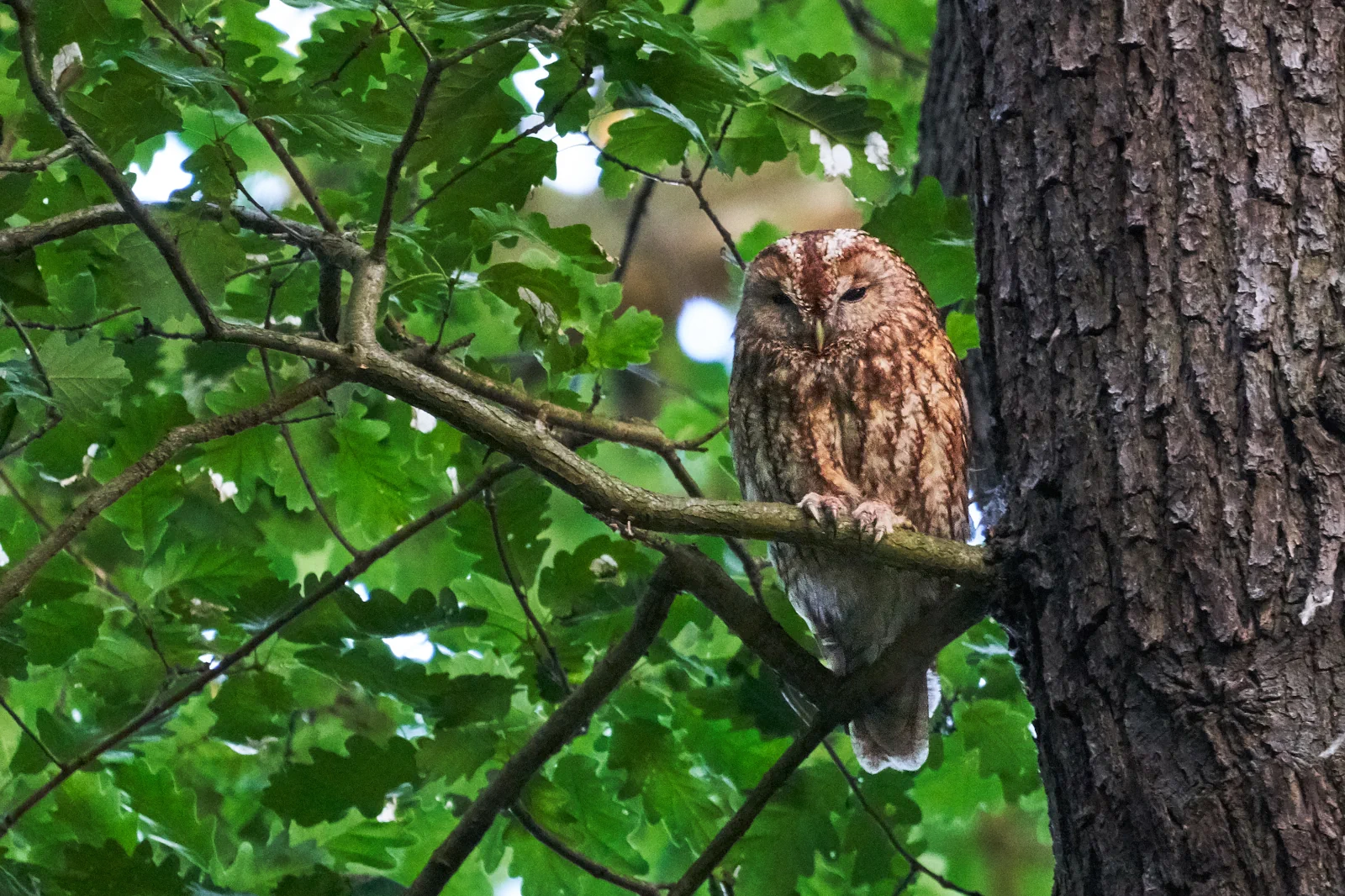
The Tawny Owl is the best known and the quietest of our forest owls. With its round head lacking ear tufts, its large black eyes set facing forward, its pale grey facial disc and its finely mottled brown or grey plumage, it blends perfectly into bark and branches. It is called "tawny owl" in reference to its characteristic call, that melancholy "hoo-hoo" which carries far through the still night and has echoed through centuries of folklore. It is found in deciduous and mixed woodlands, old parks, orchards and villages with age-old buildings, wherever hollow old trees and dense vegetation remain. The Tawny Owl is a bird of silence and of the forest, one that has lived alongside man without ever truly submitting to him.
But behind this apparent familiarity hides a Strigid with unsuspected resources. The Tawny Owl is not merely "the black-eyed owl that sings at night": it is a formidable hunter able to swoop on a mouse from a dead branch, a versatile predator whose diet adapts to seasonal availability, an opportunistic nester that occupies natural and artificial cavities alike, and a valuable indicator of the health of ancient forests and structured parkland. To observe it is to understand that mature woodland and hollow old trees are not decoration but essential habitat for an entire community of nocturnal animals.
Classification
The Tawny Owl belongs to the family Strigidae, which gathers the true owls (some 230 species found on every continent except Antarctica). It is the Eurasian representative of the genus Strix, the wood owls, which also includes the Great Grey Owl (Strix nebulosa), while the Boreal Owl (Aegolius funereus) belongs to a separate genus. The English name "tawny owl" refers to its warm brown plumage, while the scientific name aluco comes from an old Latin distortion denoting owls in general. It is a carnivorous bird, feeding mainly on small mammals and small vertebrates, tied to structured wooded habitats with cavities. Several subspecies are recognised across its Eurasian range; the only one present in France is the nominate subspecies Strix aluco aluco.
Identification
The Tawny Owl is a medium-sized nocturnal raptor with a stocky body and a round head without ear tufts. Its length is about 34 to 37 cm, for a wingspan of 94 to 104 cm and a weight of 360 to 450 grams (females being distinctly heavier). Sexual dimorphism is slight but the female is larger and heavier. Adult plumage comes in two main colour forms: a rufous-brown variant with dark streaks, and an ash-grey variant with black spots; both forms may coexist within a single population and interbreed. The face is rounded, with a well-defined pale grey facial disc framing two large black eyes (a major distinguishing feature among European Strigidae), and two white eyebrows above the eyes. The bill is yellowish-green, short and hooked. The legs are feathered down to the toes, long and powerful, with sharp talons. In flight, the silhouette is bulky, the wings broad and rounded, the flight silent and undulating. Confusion is possible with the Long-eared Owl (Asio otus), but the latter has ear tufts, a different facial disc and is partially migratory. Confusion is also possible with the Little Owl (Athene noctua), but the latter is smaller, has yellow eyes and is often active by day.
Calls and songs
The Tawny Owl is famous for its song, one of the most evocative of our forest nights. The male's territorial song is a series of deep, modulated "hoo-hoo"s, often begun with a descending low note ("hooo... hoo-hoo"), repeated insistantly from a high perch. This melancholy song carries very far through the still night and allows territories to be located from February-March onwards, sometimes even in January during mild winters. A second typical call, given by both sexes, is a shrill, wavering "kee-wick", often described as a wail or a prolonged mewing, used in exchanges between partners. The alarm call is a rapid, dry "krek-krek-krek", uttered when the bird feels threatened near the nest. The female gives softer, guttural sounds at the nest, and the young, before fledging, utter hoarse, insistent begging calls from the cavity. These calls can be heard several hundred metres away in the forest.
Habitat
The Tawny Owl favours structured woodland with nesting cavities and open ground nearby for hunting. It is found in deciduous and mixed forests, riverside woods, old parks, traditional orchards, wooded hedgerows and villages with old buildings and large trees. It needs three fundamental elements: hunting grounds with low cover (forest edges, clearings, adjoining meadows where it spots its prey), nesting cavities (hollow old trees, woodpecker holes, gaps in walls, nest boxes) and scattered roosting perches (dead branches, tree forks). It avoids large closed forests without edges or clearings, intensive cropland without trees, densely built urban areas without mature trees and very high mountain altitudes. A broadleaved forest with old trees, a communal park with large trees, a village with old buildings and large plane trees can all constitute suitable territory. A pair's home range covers from a few hectares to several tens of hectares depending on the abundance of prey.
Behaviour
The Tawny Owl is a strictly nocturnal raptor, though it may be active in full daylight in poor weather or during the breeding season. Its hunting behaviour is typical: it waits from a high perch, detecting the movements of prey on the ground thanks to its exceptional hearing (the asymmetry of its ears allows it to pinpoint a hidden prey with precision), then drops onto it in silent flight thanks to the special fringes of its flight feathers which muffle the sound of wingbeats. It also hunts by hovering low over the ground and by quartering along forest edges. It is shy and discreet: outside the breeding season it sits motionless in tree forks, well concealed, flying off only at the very last second. During breeding, the pair becomes territorial: the male sings to delimit the area and vigorously harasses intruders (diurnal raptors, corvids, mammals). The species is sedentary: adults remain on their territory all year round, and the young disperse in autumn a few tens of kilometres from their birthplace (juvenile dispersal well documented by ringing).
Flight
The flight of the Tawny Owl is silent, supple and undulating, among the most efficient of nocturnal raptors. Its broad, rounded wings, with velvet-edged flight feathers, almost entirely suppress the sound of wingbeats, allowing it to drop onto prey without being detected. Take-off from the perch is silent, with slow, deep beats. In flight, the silhouette is bulky, the head drawn in, the tail short, and flight alternates bouts of flapping with short glides. It never travels far: daily movements are confined to the territory, and the species does not migrate.
Diet
The Tawny Owl is an opportunistic carnivore whose diet varies with local availability. Its staple food consists of small mammals: wood mice, common voles, shrews and occasionally young rabbits. It also takes passerines (sparrows, finches), bats, lizards, frogs and occasionally small invertebrates (earthworms, large insects) as a supplement. It hunts mainly at dusk and dawn, but also throughout the night depending on moonlight and weather. The pellets, regurgitated at the foot of habitual perches or at the bottom of cavities, contain the undigested remains (fur, bones, feathers) and allow the diet to be analysed. The young are fed whole prey by both parents, the smallest receiving shredded meat, then progressively entire prey.
Breeding and nesting
Nesting begins early in the season (display is observable from January-February, laying takes place between March and May). The pair settles in a cavity: a woodpecker hole in a tree, a natural hollow in an old trunk, a gap in a stone wall, a wooden nest box, sometimes a chimney or a cavity in a building. No nest is built: the eggs are laid at the bottom of the cavity, directly on the accumulated debris. The female usually lays 3 to 5 eggs (sometimes more in good vole years), white and spherical. Incubation lasts about 28 to 30 days, carried out by the female alone, fed at the nest by the male, who also provisions the family after hatching. The young, altricial, remain in the nest for about 30 to 35 days, then venture onto neighbouring branches before fledging, continuing to be fed and watched by the parents for several more weeks. One brood per year is the rule, but a replacement clutch may occur after early failure. Fidelity to the nesting site is strong: the same hole can be occupied for years by the lineage of the same pair.
Distribution
The Tawny Owl has a vast range covering temperate and Mediterranean Europe, North Africa and much of temperate Asia as far as Japan. Absent from polar regions and some oceanic islands, it is present throughout mainland France and Corsica, from the plains to the middle mountain belt. It is absent from the most exposed Atlantic coastlines (Normandy, northern Brittany), where its density is lower, and more abundant in the forested areas of central, eastern and south-eastern France. The French breeding population is estimated at several tens of thousands of pairs (national surveys give orders of magnitude that should be verified before publication), with a trend that is broadly stable or slightly declining depending on the region. The species is sedentary across its entire French range, visible all year round.
Threats and protection
The Tawny Owl is classified as "Least Concern" (LC) globally by the IUCN (the species remaining common over most of its range), but its European and French situation is monitored attentively. It is included on the French list of protected species (destruction and disturbance prohibited) and in Annex II of the EU "Birds" Directive. The threats weighing on the species are the loss of mature forests and hollow old trees (clear-cutting, excessive pruning, replacement of trees with young plantations), agricultural intensification (disappearance of edges and hunting meadows, collapse of vole populations due to pesticides), collisions with vehicles (the owl frequently crosses forest roads at dusk), indirect poisoning by rodenticides used against rodents, and human disturbance near nesting sites (building renovation, heavily visited tourist sites). Its protection relies on maintaining and planting mature forests with old trees, conserving hunting edges and clearings, installing wooden nest boxes (an effective and proven measure), limiting pesticide use in wooded environments, and monitoring populations through night listening surveys and censuses of nesting sites.
Seeing a Tawny Owl is most often a matter of chance: a stocky shape in a tree fork, well hidden by its mottled plumage that mimics bark, its bright black eyes turned towards you, motionless as a statue. It does not move, does not fly off, watches you without blinking, perfectly merged into the scenery until the wind stirs the branch. But it is above all its call that betrays its presence: that deep, melancholy "hoo-hoo" which crosses the forest night and has haunted the human imagination for millennia. In Greek mythology it was not Minerva's owl (that was the Little Owl), but in the French countryside it was in turn the bird of ill omen and the messenger of restless souls; its cry was said to foretell death, yet it is still here, patient and faithful, in the same trees our grandparents once looked upon. Wherever it nests there are hollow old trees, peaceful edges, a mature forest that few other environments still offer. Behind its black eyes, its facial disc and its ancestral song, the Tawny Owl remains a bird of paradoxes (silent yet vocal, nocturnal yet visible, shy yet familiar with parks), whose presence says better than any speech the health of ancient woodland. And every "hoo-hoo" heard in the January night is a promise: that there are still forests old enough, calm enough, welcoming enough to shelter the most emblematic of our woodland owls.