

The Ring-necked Parakeet is one of the most remarkable, and most controversial, success stories among exotic-origin birds in Europe. Native to tropical regions of Africa and Asia, this slender, vividly coloured green parakeet (with its disproportionately long tail, red bill and black collar edged with pink in the male) has conquered our cities and parks within a few decades. Descended from escaped or released cage birds, it has become permanently established in major urban areas, where it nests in tree cavities and holes in building façades. It is found in parks, gardens, tree-lined streets, copses and urban riverside woods, wherever a mild climate and available cavities provide a roost and feeders, fruit and blossoms supply food. The Ring-necked Parakeet is a bird of leafy cities, of big hollow trees and noisy gatherings, one that has traded its tropical origins for life in temperate climates (and is doing remarkably well).
But behind this apparent success lies a parakeet with ambiguous stakes. The Ring-necked Parakeet is not merely "the little green parakeet in the park": it is a potentially formidable competitor that contests cavities with indigenous hole-nesting birds, a species that withstands the cold thanks to urban heat islands and winter feeding, a skilled navigator and first-rate food opportunist, and the subject of scientific debate between managing introduced populations and integrating them into the local avifauna. Watching it means reflecting on the relationship between urban environments and wildlife, and understanding that introduced species raise complex questions — ones that are resolved neither by total indifference nor by blind extermination.
Classification
The Ring-necked Parakeet belongs to the Psittacidae family, which gathers parrots and parakeets from around the world (more than 350 species spread across tropical and subtropical regions). It is one of the most typical members of the genus Psittacula, which also includes the Alexandrine Parakeet (Psittacula eupatria) and the Mauritius Parakeet (Psittacula echo). The English name "ring-necked" refers to the black band encircling the male's neck. The scientific name krameri honours the Austrian naturalist Wilhelm Kramer. It is a frugivorous and granivorous bird, mainly associated with open landscapes, light woodland and human-made habitats: urban parks, orchards, plantations, parks and gardens. Four subspecies are recognised across its Afro-Asian range, two of which now breed in Western Europe (the nominate Psittacula krameri krameri, of African origin, and P. k. manillensis, from South Asia).
Identification
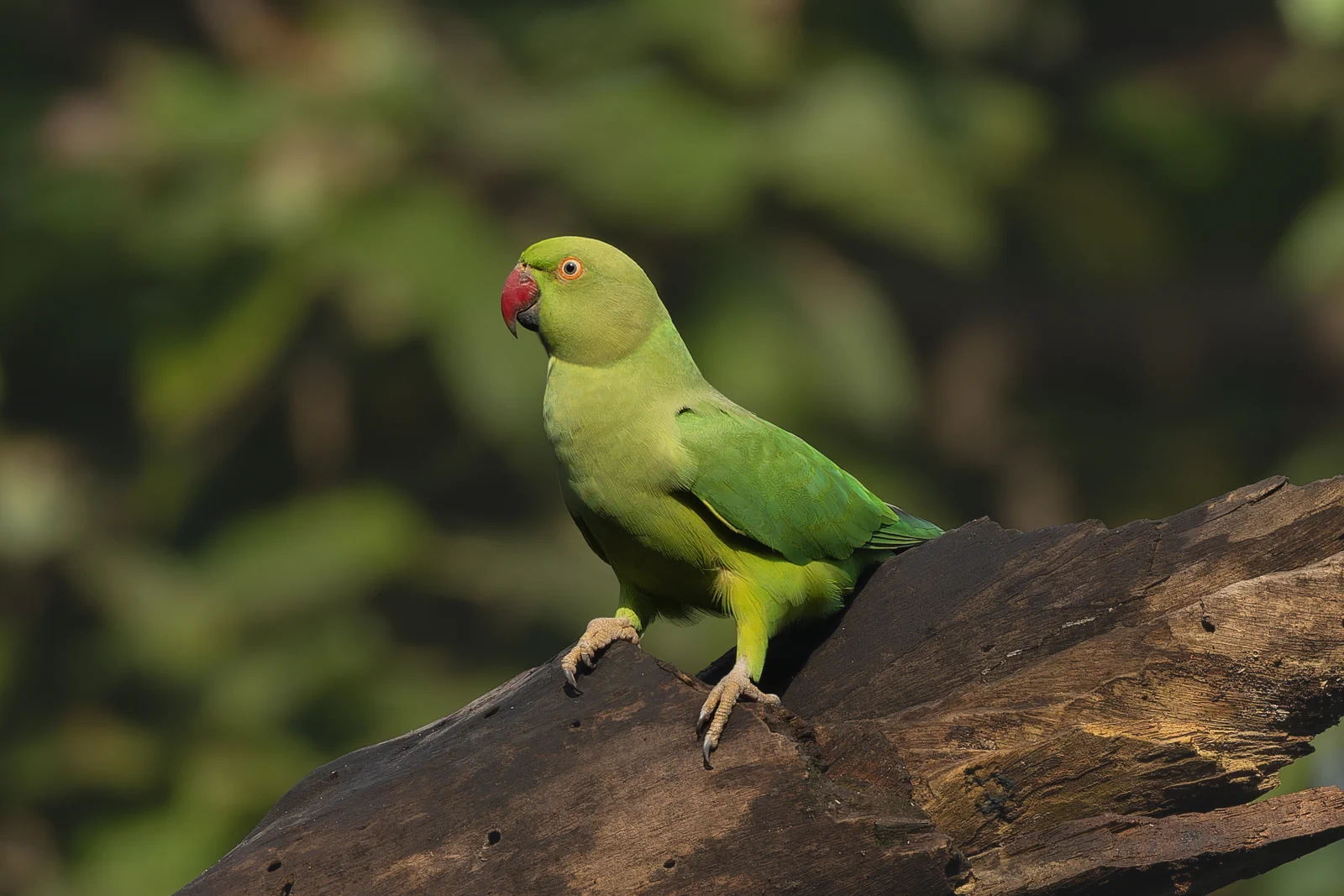
The Ring-necked Parakeet is a medium-sized parakeet with a slender body and highly distinctive silhouette. It measures around 40 cm in length (half of which is the tail alone), with a wingspan of 42 to 48 cm and a weight of 110 to 140 grams (males being slightly heavier). Sexual dimorphism is visible in breeding plumage (though the sexes remain hard to tell apart in young birds for a long time). The adult shows bright apple-green plumage, with a coral-red (upper) bill and slightly paler underparts. In breeding plumage the male wears a black collar running from the chin down towards the nape, bordered beneath by a fine pink band (the diagnostic feature of the adult male). The female lacks this collar: her head is uniformly green. The undertail coverts are yellowish-green. Immatures resemble adults but lack the black collar (which only appears at around two years of age) and have a paler bill. Confusion is possible with the Alexandrine Parakeet (Psittacula eupatria), but that species is distinctly larger, with a broader bill and a red shoulder patch (absent in the Ring-necked Parakeet). Confusion is also possible with the Budgerigar (Melopsittacus undulatus), but the latter is much smaller, with an entirely different build and a shorter tail.
Songs and calls
The Ring-necked Parakeet is a vocal, noisy and chatty bird, especially in groups. Its most typical call is a dry, shrill, repeated "ki-ki-ki" or "kriii", given in flight, at perch and during social contact. This strident call, repeated insistently, is characteristic of parakeet flights crossing urban neighbourhoods in daylight (a parakeet flock is often heard long before it is seen). The alarm call is a short, vibrating "krrih". During courtship, the pair exchanges soft, chatty vocalisations mixing warbles, murmurings and small melodious calls. Young birds give sharp, insistent begging calls, repeated "si-si-si", to solicit their parents. Unlike true parrots, the Ring-necked Parakeet shows no remarkable mimicking ability in the wild (though captive individuals can learn words). These calls carry over several hundred metres in green neighbourhoods and parks.
Habitat
The Ring-necked Parakeet favours open, green, fruit-tree-rich habitats, whether natural or man-made. Within its native range, it is found in savannas, forest edges, semi-open landscapes and farmland. In Europe it has colonised a more urban spectrum: parks, gardens, campuses, tree-lined avenues, large orchards, canal banks. It needs two fundamental elements: a big hollow tree (plane, poplar, sweet chestnut) or an artificial cavity to nest in, and an accessible food source (fruit, seeds, blossoms, feeders, winter feeding stations). Unlike most indigenous birds, it thrives in major cities (Paris, London, Brussels, Rome, Barcelona, Amsterdam), thanks to the relative warmth of cities (urban heat islands) and the abundance of food provided by people. A large hollow tree in a park, an avenue of mature trees or a green neighbourhood with feeders can all constitute suitable habitat. A pair's home range is small, but colonies exploit a radius of several kilometres around the nesting site.
Behaviour
The Ring-necked Parakeet is a social, gregarious bird that gathers in noisy flocks outside the breeding season. In autumn and winter it forms sometimes sizeable communal roosts (several hundred birds), often in isolated trees or urban copses, which disperse at dawn in noisy columns towards feeding grounds. Its feeding behaviour is agile: it climbs along branches, hangs upside down to reach fruit, picks seeds and strips blossoms (especially cherry buds and flowers in spring). In the city it is tolerant and rather tame, sometimes allowing observation from a few metres away, yet it remains watchful and flies off together at the slightest alarm, in fast, direct flight with loud calls. At nesting time it becomes territorial: the pair defends its cavity against all other birds, including crows (vigorous conflicts with Green Woodpeckers, Little Owls and swifts over nest holes). The Ring-necked Parakeet is sedentary: it does not migrate and stays in the same place year-round, moving locally towards winter food sources.
Flight
The Ring-necked Parakeet's flight is fast, direct and slightly undulating, with a characteristic silhouette: an elongated body, sharply pointed wings beaten powerfully, and the very long tapered tail streaming behind in a line (a diagnostic feature in flight). Wingbeats are quick and regular, carrying it across the landscape in straight lines between parks, feeders and roosts. Take-off is immediate and noisy: the bird springs from a tree with a sharp beat, accompanied by calls, and launches into a low, fast flight above rooftops and avenues. In flocks, movements are quick and synchronised, with constant calls announcing the flight from afar. The Ring-necked Parakeet almost never travels in large groups over long distances, moving instead in family parties or small colonies. It lands with ease, flight also serving daily commuting (from roost to feeding grounds), but it is sedentary and rarely crosses long distances.
Diet
The Ring-necked Parakeet is a granivorous-frugivorous, opportunistic bird, well adapted to urban resources. Its diet is dominated by fruit, seeds, buds and blossoms, depending on the season. It takes a variety of fruits (apples, figs, cherries, blackberries, wild berries), seeds of cultivated and wild plants, buds and tender leaves, flower buds (parakeets cause notorious damage to orchards and fruit crops), and flowers (especially those of ornamental trees). In winter it frequents feeders (sunflower seeds, peanuts, seed mixes) and benefits massively from people's winter feeding. It explores gardens, parks, vegetable plots and cemeteries, where resources abound. It picks fallen seeds from the ground and inspects fruit trees in gardens and orchards. The young receive ripe fruit and regurgitated seeds from their parents.
Breeding and nesting
Nesting begins in spring, as early as March–April in temperate regions. The pair sets up its nest in a natural cavity: an old woodpecker hole, a branch crack, a hollow in a large tree, a gap in a façade, a wall hole, sometimes an empty Starling nest. The cavity is lined with wood chips, fibres and plant debris. The female usually lays 3 to 6 smooth white eggs. Incubation lasts about 23 to 25 days, carried out mainly by the female, while the male guards the cavity entrance and brings her food. After hatching, the young stay in the nest for about 6 to 7 weeks, fed by both parents by regurgitation. They fledge in late summer and stay with the family for a few more weeks before joining nomadic flocks. One brood per year is the rule, but a replacement clutch may follow an early failure. The Ring-necked Parakeet does not build an enclosed nest in the manner of parrots, but uses natural cavities, which places it in direct competition with indigenous hole-nesting birds (woodpeckers, owls, starlings, tits).
Distribution
The Ring-necked Parakeet is native to sub-Saharan tropical Africa and South Asia (from Pakistan to Myanmar), and its current range in Europe results from successive introductions stemming from the cage-bird trade (escapes and releases since the 19th century, with massive establishment from the 1960s onwards). In Europe, it now breeds in Great Britain (tens of thousands of birds), the Netherlands, Belgium, Germany, France, Spain, Italy and Greece, with strong populations in temperate cities. In France, it occurs mainly in the Paris region (its main French stronghold, with several thousand birds), in Lyon, Marseille, Toulouse, Lille and a few other major cities. The French population is estimated between several hundred and several thousand birds, in constant growth since the 1990s. The Ring-necked Parakeet is therefore an exotic-origin, sedentary and expanding species in France, particularly in the parks and green neighbourhoods of large urban areas.
Threats and protection
The Ring-necked Parakeet is classified as "Least Concern" (LC) by the IUCN worldwide, within its native range. Its situation in Europe is different: it is an introduced species, enjoying no legal protection as an indigenous bird and not listed in Annex I of the EU Birds Directive. Its expansion raises conservation questions: by contesting cavities with indigenous hole-nesting birds (Western Jackdaw, Little Owl, Great Spotted Woodpecker, Common Swift, House Sparrow), it could exert competitive pressure on local species. It also inflicts damage on orchards and crops, and locally contributes to spreading seeds of invasive plants. However, scientific studies carried out in Europe have not demonstrated any major impact at large scale, and its status as a pest remains debated. In France, it is not legally classified as an invasive alien species in the strict regulatory sense, but scientific monitoring (notably by ornithological networks) keeps track of its evolution. The threats weighing on it are indirect: ambushes by urban predators (Common Kestrels, Sparrowhawks, cats), collisions with windows and vehicles, harsh winters (higher mortality in unfed populations), and interventionist population management in some countries. Its legal protection is contested (its status as an introduced species precludes any favourable regulation), but it remains present in our cities, where it is durably established.
Watching a Ring-necked Parakeet means first hearing it, then being surprised. Its dry, metallic call rings through parks as an improbable echo to the choruses of sparrows and the songs of blackbirds, and the eye first looks for a caged parrot before realising that the bird is truly there, free, in the hollow of a Parisian plane tree or a Marseille hackberry. When the flight passes, fast and noisy, you glimpse a green arrow with an outsized tail, wings beating at full speed, before the flock vanishes behind the rooftops. At winter feeders, the green parakeets strip sunflower seeds with surgical skill, joining tits and finches in a mingling of species that did not exist forty years ago. In spring, the male shows off in the trees, green-headed, his black-and-pink collar gleaming, displaying before the female in a slow, stately circling flight (a modest, cheerful aerial dance that says nothing of the spectacular displays of other parakeets, yet is no less effective). What strikes most of all, though, is the questioning this presence provokes: should we protect it, hunt it, ignore it? Is it a threat to our hole-nesting birds, a new richness for our cities, a symbol of how global trade reshuffles faunas? Wherever it settles, there are big hollow trees, abundant fruit, a measure of climatic mildness, a city that tolerates its exotic guests. Behind its brilliant green plumage, red bill and piercing call, the Ring-necked Parakeet remains a bird of paradoxes (tropical yet hardy, domestic yet wild, charming yet controversial), whose presence in our parks reminds us that wildlife evolves and that our relationship with introduced species is more complex than it seems. And every green silhouette crossing the sky of an urban park is a living debate: one that questions our relationship with nature, between conserving our indigenous species and the welcoming surprise of newcomers (a coexistence that calls for reflection, dialogue and informed decision-making).