

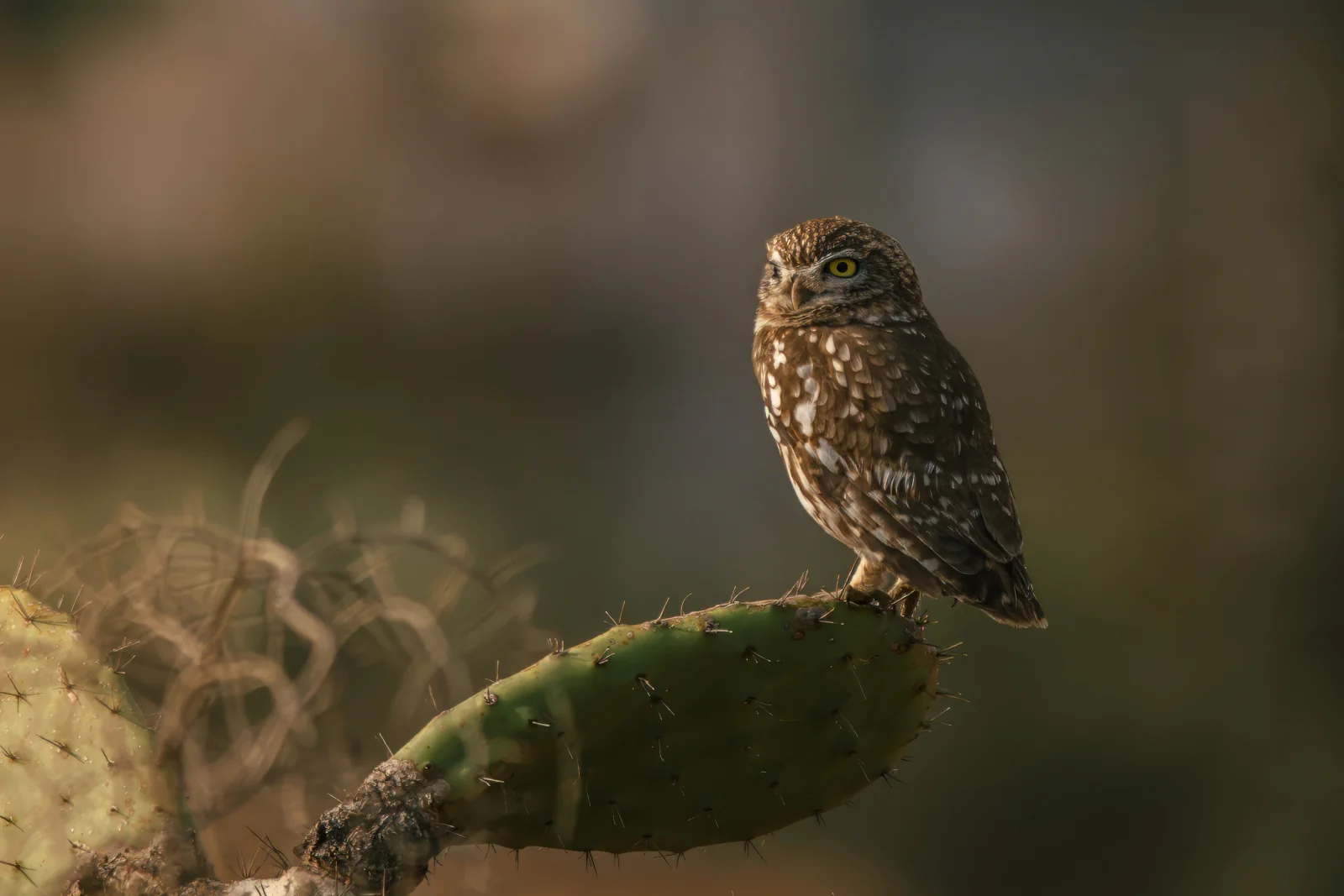
The Little Owl is the most diurnal and the most familiar of our owls. With its stocky little silhouette and upright posture, it readily perches in broad daylight at the top of a fence post, an electricity pole or a dead branch, scanning the ground with its large yellow eyes beneath white eyebrows that give it a permanently astonished expression. With its flattened, broad head, its brown back speckled with white, its white belly streaked with brown, and the false eyes on the back of its head (two pale patches that fool predators), it resembles no other European nocturnal raptor. It is found in hedged farmland, orchards, grazed meadows, villages with old timber-framed buildings and open wasteland — wherever short grass, cavities and perches abound. The Little Owl is a bird of ancient agricultural landscapes, of low hedges and old hollow trees, one that has followed people into the countryside for millennia (the Greeks already regarded it as the companion of Athena, goddess of wisdom).
But behind this apparent familiarity lies a Strigid of unsuspected resources. The Little Owl is not merely « the little owl of the apple orchards »: it is a tenacious hunter capable of swooping on a mouse from its perch, a versatile predator that catches insects on the ground as readily as a vole in flight, an opportunistic nester that settles just as easily in an old woodpecker hole as in a wall crevice, a chimney or a rabbit burrow, and a striking indicator of the health of our hedged farmland. To observe it is to understand that traditional agricultural landscapes (meadows, hedges, orchards, stone walls) are not rustic decoration but complete ecosystems, whose silent disappearance sweeps away the birds that once inhabited them.
Classification
The Little Owl belongs to the family Strigidae, which gathers the owls sensu stricto (roughly 230 species found on every continent except Antarctica). It is the Eurasian and North African representative of the genus Athene, which also includes the Spotted Owlet (Athene brama) of South Asia and the Burrowing Owl of North America (formerly Speotyto cunicularia, now Athene cunicularia). Its scientific name honours Athena, the Greek goddess of wisdom whose emblematic bird it was (the little owl of the Olympian religion already appeared on Athenian coins). It is a carnivorous bird, feeding on small vertebrates and invertebrates, tied to open and semi-open landscapes with old trees: hedged farmland, orchards, meadows, steppes, Mediterranean scrubland and villages. Several subspecies are recognised across its vast range (from western Europe to China); the only one present in France is the nominate subspecies Athene noctua noctua.
Identification
The Little Owl is a small nocturnal raptor with a stocky body and a large head. It measures about 21 to 27 cm in length, with a wingspan of 50 to 56 cm and a weight of 140 to 220 grams (females being slightly heavier). Sexual dimorphism is slight and barely noticeable in the field. The adult plumage shows an earth-brown back spotted and stippled with white, a white to buff belly heavily streaked with brown, a large, broad, flat head with no ear tufts, a poorly marked facial disc, and two big yellow eyes topped by clearly visible white eyebrows (which contribute to its alert, curious expression). Two pale patches sometimes adorn the nape (so-called « false eyes », meant to deter predators approaching from behind). The bill is greenish-yellow, short and hooked. The legs are feathered down to the toes, long and sturdy (an adaptation for hunting on the ground). In flight, the short, rounded wings beat with a soft undulating motion, recalling an oversized Great Spotted Woodpecker. The female is identical to the male, very slightly larger. Immatures resemble adults, with a fluffier plumage and less distinct streaks. Confusion is possible with the Tawny Owl (Strix aluco), but the latter is distinctly larger, with a round head and dark eyes (not yellow), whereas the Little Owl is often active by day. Confusion is also possible with the Eurasian Scops Owl (Otus scops), but the latter is smaller, greyish-brown and arboreal, with small ear tufts, and strictly nocturnal and migratory.
Songs and calls
The Little Owl is a vocal bird, chiefly at dusk and early in the night, but also on grey days. The territorial song of the male is a soft, melancholy « goo-goo » or « koo-koo », sometimes slightly descending, repeated insistantly from an elevated perch (rooftop, treetop, pylon). This mournful song, familiar in old villages, carries far through the still night air and allows territories to be located from February–March onwards. A second typical call, given by both sexes, is a rising, plaintive, questioning « gweeeh » or « dji-hii », often described as a shrill mewing. The alarm call is a sharp, fast, dry « kwi-kwi-kwi ». The female gives more guttural calls at the nest, and the young, before fledging, utter hoarse, insistent begging calls from within the cavity (a dull, regular rattling that is often the first clue to the presence of a nest in an old orchard). The Little Owl will also call during the day in some areas: it is sometimes heard singing in the middle of the afternoon in overcast weather.
Habitat
The Little Owl favours open and semi-open landscapes with low vegetation, structured by perches and rich in cavities. It is found in grazed hedgerow country, old standard orchards, grazed meadows, rough grassland, heathland, Mediterranean scrubland, limestone steppe, abandoned quarries and villages with stone walls and old buildings. It requires three fundamental elements: open hunting grounds with short grass (hay meadows and pastures, where it spots prey from a low perch), nesting cavities (old hollow trees, woodpecker holes, drystone walls, piles of stones, rabbit burrows) and scattered hunting perches (posts, electric wires, isolated trees), around which its daily life revolves. It avoids dense forests, intensive crops lacking perches or cavities, densely built-up urban areas and high mountain elevations. A traditional orchard bordered by meadows, a hedged landscape with pollarded old trees, or a stony scrubland with field-clearance cairns can all constitute suitable territory. A pair's home range covers from a few hectares to thirty or so depending on habitat quality (radio-tracking studies provide the most precise figures region by region).
Behaviour
The Little Owl is one of the most diurnal of European nocturnal raptors: it is readily observed in full daylight, perched conspicuously at the top of a post or wire, motionless but perfectly awake, bobbing its head or leaning towards the ground when a movement catches its attention. Its hunting behaviour is characteristic: it hunts by ambushing from a low perch, dropping onto prey spotted on the ground in a short, direct flight and seizing it with its talons. It also hunts on the ground, running and hopping after insects and worms (a comical gait well known to observers), and can catch prey in flight (bats, passerines at dusk). It is wary yet curious: in response to playback it answers quickly and comes to inspect the intruder, which facilitates surveys but demands disciplined use. During the breeding season the pair is territorial, the male singing to delineate the area and both partners fiercely mobbing intruders (passerines, corvids, but also cats and diurnal raptors). The species is sedentary: adults remain on their territory year-round, and the only notable movements involve young of the year, which disperse in autumn a few tens of kilometres from their birthplace (juvenile dispersion, well documented by ringing).
Flight
The flight of the Little Owl is agile, fast and undulating, with quick wingbeats interspersed with short glides. The short, rounded wings, adapted to short trips between perches, produce a flight that lacks endurance but is highly manoeuvrable: the owl slaloms between trees, skims low over the grass, and drops onto prey in direct, brief trajectories. Take-off from the perch is immediate, with a brisk, silent beat (the soft fringes of the flight feathers, shared by all Strigids, suppress flight noise). In flight the silhouette is stocky, the head tucked in, the tail short; the regular undulation of wingbeats means it can be mistaken at a distance for a Great Spotted Woodpecker (a resemblance reinforced by its low, jerky flight). It never travels far: daily movements are confined to the territory, and the species does not migrate.
Diet
The Little Owl is an opportunistic carnivore with an exceptionally broad diet. Its food varies greatly with season and habitat: in summer it feeds mainly on insects (ground beetles, mole crickets, grasshoppers, crickets) and earthworms (gathered on the ground after rain), supplemented by woodlice and spiders. In winter and spring, small mammals take over: voles, field mice, shrews and young rats, captured by ambush from perches. It also takes passerines, lizards, frogs, bats and occasionally injured small birds. The pellets, regurgitated at the foot of habitual perches, are small and well known to naturalists (they allow the diet to be reconstructed through analysis of bone remains). The young are fed prey of increasing size, from insects to voles, depending on their age.
Breeding
Nesting begins early in the season (display is observable from February, laying occurs between late March and May). The pair settles in a cavity: a woodpecker hole in an old orchard, a hollow in a pollarded tree, a crevice in a stone wall, a pile of stones, a wood stack, a roof space, and sometimes an old rabbit or badger burrow (a behaviour inherited from the species' steppe origins). No nest is built: the eggs are laid at the bottom of the cavity, on accumulated debris. The female typically lays 3 to 5 eggs (occasionally more in good vole years), white and almost spherical. Incubation lasts about 27 to 29 days, carried out by the female alone, fed at the nest by the male, who also provisions the family after hatching. The young, nidicolous, remain at the nest for roughly 3 to 4 weeks, then venture onto neighbouring branches before fledging, continuing to be fed and watched over by the parents for several more weeks. The young depend on the adults until 6 to 8 weeks after fledging. One brood per year is the rule, but a replacement clutch may occur after an early failure. Fidelity to the nest site is strong: the same hole may be occupied for many years by the lineage of a single pair.
Distribution
The Little Owl has a vast range covering temperate and Mediterranean Europe, North Africa and much of temperate Asia as far as China and Korea. Absent from the northern British Isles and Scandinavia, it is present throughout mainland France and Corsica, from the plains to the mountain belt, with strongholds in the hedged farmland of the West and Centre, the orchards of the Loire Valley and the South-West, the Mediterranean scrubland and the limestone plateaux. The French breeding population is estimated at some tens of thousands of pairs (successive national surveys by the LPO volunteer network and other organisations give orders of magnitude that should be verified before publication, the last dedicated national survey already dating back some years), but the trend is a sharp decline in most lowland regions. The species is sedentary across its entire French range, visible all year round.
Threats and protection
The Little Owl is classed as « Least Concern » (LC) globally by the IUCN (the species remaining common in Asia), but its European and French situation is markedly more worrying: it is considered vulnerable in France and is in steep decline in intensive arable regions. It is on the French protected species list (destruction and disturbance prohibited) and in Annex II of the EU Birds Directive. The causes of its decline are well documented: agricultural intensification (ploughing of grasslands, removal of hedges, loss of perches and cavities, collapse of vole and insect populations due to pesticides), disappearance of old standard orchards and pollarded trees (replaced by wall-trained dwarf orchards with no cavities), renovation of rural buildings (loss of crevices in walls and roofs), road traffic (the Little Owl, which hunts at ground level along road edges, is a regular victim of collisions), and indirect poisoning by rodenticides and insecticides. Its protection involves maintaining and replanting traditional orchards and pollarded trees, installing wooden nest boxes (an effective, proven measure widely used by local monitoring networks), conserving hedges and fence posts, reducing pesticide use, mitigating traffic on high-risk roads, and monitoring populations through night listening and nest-box surveys.
Seeing a Little Owl often happens by chance: a stocky little shape at the top of a fence post, fixing you with its large yellow eyes as it tilts its head, following your every move without stirring, then suddenly diving into the grass to return with an earthworm dangling from its bill. Its upright posture and feigned gravity have fed a thousand legends (in ancient Greece its silhouette struck Athenian silver coins, a symbol of wisdom and vigilance; in the French countryside, its night calls once fuelled many superstitions, and it took centuries for folk wisdom to catch up with that of the Greeks). But there is something more moving still than legend: its presence has today become a rarity. Wherever the old orchard survives with its hollow trees, wherever meadows are mown late and the posts still stand, it keeps watch; elsewhere, in fields ploughed to the horizon, it has vanished without a sound, swept away by the loss of its perches, its prey and its holes. This is why every sighting counts, and every orchard planted, every pollarded tree cut, every nest box installed is a step towards its return. To find it, look first at the pollarded trees towering overhead — big yellow eyes watching you in silence — scan the wires and posts of a quiet corner, but above all listen for it at dusk in February: that soft, sad « goo-goo » rising from the old orchards is a call from another rural era, that of hedges and stone walls. Behind its white eyebrows, its false eyes and its ever-astonished air, the Little Owl remains a bird of paradoxes (nocturnal yet diurnal, wise yet fierce, familiar in villages yet wary when nesting), whose silent retreat says better than any speech what the countryside has lost. And every little pair that settles in a pollarded tree is a promise: that landscapes still exist gentle enough, hollow enough, hospitable enough to shelter the little owl of the goddess Athena.