

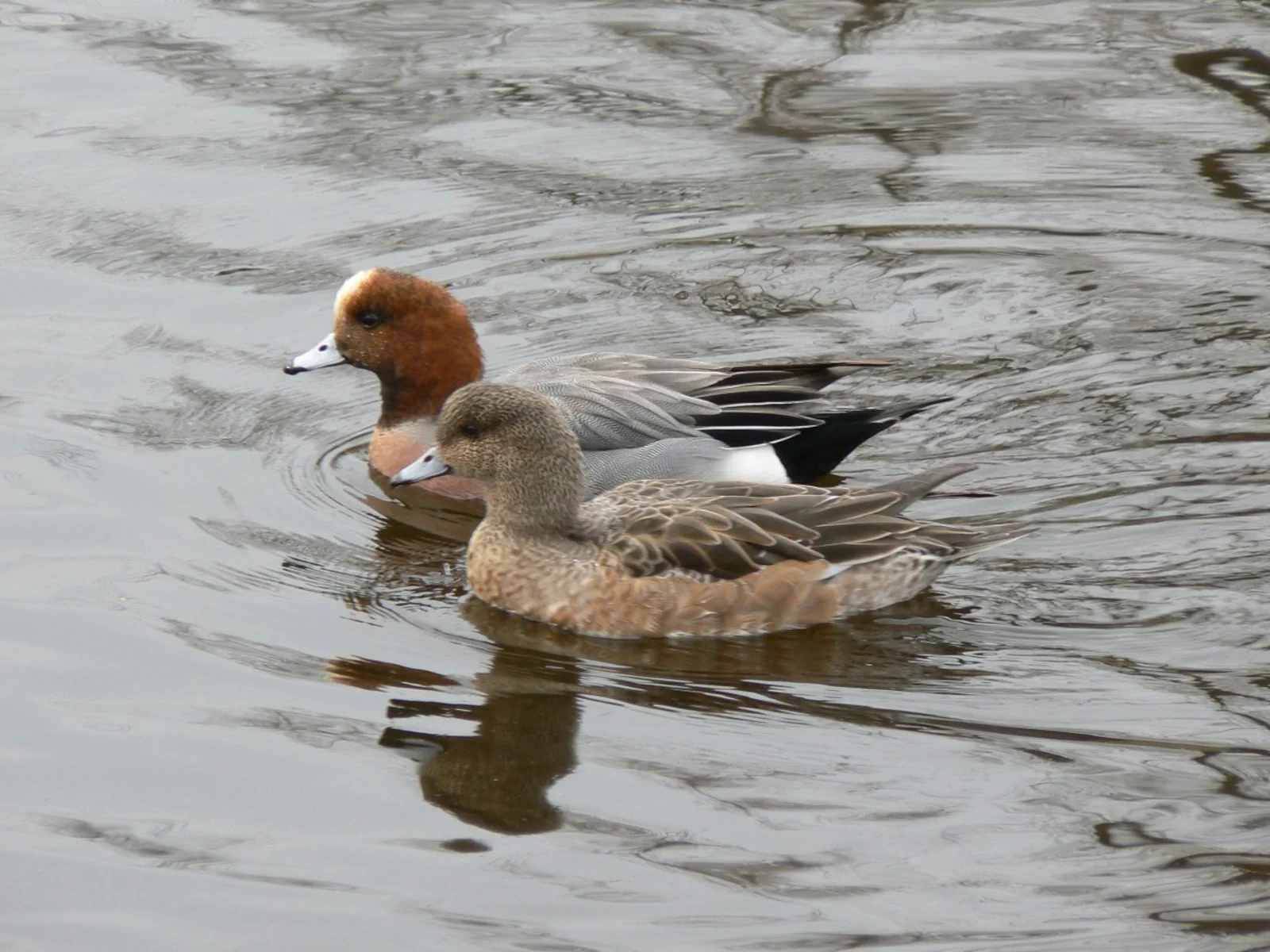
The Eurasian Wigeon is one of the most elegant and graceful ducks of our wetlands. With its pale rufous head, its yellow-orange forehead, its piercing grey-blue eyes and its finely vermiculated grey body, it evokes a streamlined, aerodynamic silhouette that glides across the water with remarkable ease. But what earned this species its French name is its call: a high, melodious, two-toned whistle, often described as a "pseeep" or "wi-wi", uttered in flight with a musical fluidity that carries far above the ponds. When a flock of wigeons crosses the autumn sky, their crystalline whistles are heard before their grey silhouettes can even be seen. It is found in shallow freshwater, marshes, ponds, lagoons, wet meadows and floodplains, wherever aquatic grassbeds abound. The Eurasian Wigeon is a bird of turf and grass, browsing tender vegetation and young shoots like a terrestrial herbivore, unlike most ducks which filter or sift the sediments.
Yet behind this apparent elegance hides an anatid with unsuspected resources. The Eurasian Wigeon is not merely "the whistling duck": it is a specialised grazer that feeds heavily on grass, young shoots and tender leaves, a fast migrant whose tight flocks cross Europe at great speed, a wet-meadow nester that builds its nest on the ground in open clearings far from the water's edge, and a bird whose winter plumage stands out for a delicacy of pattern rare among ducks. Observing it is to understand that ducks are not confined to open water, and that some have developed feeding strategies that bring them closer to terrestrial herbivores.
Classification
The Eurasian Wigeon belongs to the Anatidae family, which brings together the ducks, geese and swans of the world (more than 170 species found on every continent except Antarctica). It is one of the representatives of the genus Mareca, which includes the wigeons and their close relatives (formerly placed in the genus Anas, now separated on phylogenetic grounds). The French name of the species refers to its characteristic whistled call. The scientific name penelope evokes Penelope, the wife of Ulysses, famed for her fidelity (a mythological allusion to the faithfulness of pairs). It is a herbivorous, mainly vegetarian bird, tied to aquatic habitats and wet meadows: marshes, ponds, lagoons, floodplains and coastal pastures. The species is monotypic across its Eurasian range, with no subspecies clearly recognised in Europe.
Identification
The Eurasian Wigeon is a medium-sized duck, slightly smaller than the Mallard but with a more streamlined body. Its length is about 45 to 53 cm, for a wingspan of 71 to 80 cm and a weight of 600 to 1,000 grams (females being slightly lighter). Sexual dimorphism is pronounced in breeding plumage. The male has a pale rufous head with a yellow-orange crown stripe running from the bill to the nape, a grey-blue eye surrounded by a black ring, a pale pink breast, grey flanks finely vermiculated with white, an ash-grey back and a black tail with elongated central rectrices (a diagnostic feature). The bill is black, short and straight. The legs are greyish. The female is uniformly grey-brown, with a dark patch around the eye and pale vermiculations on the flanks; she is duller but retains an elegant, slender outline. Immatures resemble the female but are duller, with a less marked head. In eclipse plumage, the male loses his bright colours and temporarily resembles the female, with a browner head and a less pink breast. Confusion is possible with the Mallard, but the slimmer silhouette, the shorter bill and the different call immediately identify the Wigeon. Confusion is also possible with the Eurasian Teal, but the latter is distinctly smaller, with a shorter bill and a characteristic green wing patch absent in the Wigeon.
Calls and songs
The Eurasian Wigeon is famous for its characteristic whistled call, one of the most melodious of all ducks. The most typical call is a two-toned, high-pitched rising whistle, described as a "pseeep" or "wi-wi", uttered in flight by both sexes, often in duet by paired birds. This call, produced by a modified trachea that amplifies the vibrations, carries far above the wetlands: a flock of wigeons can be heard several hundred metres away, especially on migration when flocks pass at high altitude. The female's alarm call is a hoarse, brief "kwak", less powerful than that of the Mallard. During courtship, the pair exchanges soft, whistled vocalisations: the male whistles rising notes while the female answers with deeper ones, in a melodious dialogue that strengthens the pair bond. The young give sharp, insistent peeping calls, repeated "pi-pi-pi", to beg from their parents. These calls carry several tens of metres across the wetlands.
Habitat
The Eurasian Wigeon favours calm, shallow freshwater rich in aquatic vegetation, along with adjacent wet meadows. It is found on ponds, marshes, lagoons, floodplains, coastal pastures, polders, reservoirs and fields flooded after the harvest, wherever grassbeds and young shoots provide abundant food. It needs two fundamental elements: shallow water with emergent vegetation (reeds, bulrushes, cattails) for nesting and cover, and open adjacent grassland for grazing (meadows, stubble fields, pastures). Unlike the Mallard, it prefers open spaces rather than wooded riversides. It avoids deep water with no shallow areas, wholly open landscapes without adjacent meadows, turbid water poor in vegetation, and areas heavily used by people. A pond bordered by floodable meadow, a marsh with open channels and grazing land, a flooded plain with fallow fields can all constitute suitable habitat. A pair's home range generally covers a few square kilometres. In winter, it frequents a wider range of habitats: estuaries, polders, farmland, coastal pastures and large lagoons.
Behaviour
The Eurasian Wigeon is a sociable bird, gathering in sizeable groups outside the breeding season. On migration and in winter it forms flocks of tens to thousands of birds, often mixed with other herbivorous ducks (teals, geese). Its feeding behaviour is characteristic: it grazes on grasses, young shoots and tender leaves both on land and on water, either browsing directly on the meadows or dipping its head into submerged grassbeds and pulling at the vegetation with its bill. It is known for an almost purely herbivorous diet at times, feeding heavily on grass, sprouted wheat, roots and tubers. It is wary and vigilant: groups scatter quickly at the slightest disturbance, but can become fairly trusting within protected areas. During nesting it becomes territorial: the pair defends a small area around the nest, driving away intruders with pursuits on the water and hoarse calls. The Eurasian Wigeon is a partial migrant: northern and central European populations leave their breeding quarters as early as September-October for the open plains and wetlands of western Europe, the Mediterranean basin and North Africa. The return journey takes place in March-April.
Flight
The flight of the Eurasian Wigeon is fast, direct and graceful, one of the most elegant among ducks. It beats its wings at a rapid, steady rhythm, flying in a straight line between two patches of water. Taking off is relatively easy (thanks to its streamlined silhouette): the bird rises from the water or the grass after a short run, with brisk, sustained wingbeats. On migration the flight becomes higher and more sustained, often in tight groups or compact V-formations, typical of fast-flying ducks. The Eurasian Wigeon travels by day and by night, crossing the Mediterranean and sometimes the Sahara for northern populations, and settles at dawn in wetlands to rest. This is why it is often seen on active migration: spring and autumn movements are regular along the major flyways and at the great French stopover sites (Camargue, Languedoc lagoons, Baie de Somme, Rhône valley, Flemish polders).
Feeding
The Eurasian Wigeon is a herbivore, mainly vegetarian, whose diet is dominated by aquatic and terrestrial plants. Its food varies with the season and local availability of resources. In the breeding season, it feeds mainly on aquatic vegetation: tender leaves of hydrophytes, young shoots, seeds of aquatic plants, and occasionally small aquatic invertebrates (insect larvae, crustaceans, molluscs) to boost its protein intake. In winter it becomes largely granivorous and folivorous: it eats grass on flooded meadows, young cereal shoots in the fields, roots, tubers, acorns in oakwoods and harvest leftovers (maize, wheat, barley) in the stubble. It grazes by walking slowly on land, or by dipping its head into submerged grassbeds. The young receive protein-rich animal prey during their first weeks (mainly insect larvae and small crustaceans), essential for their rapid growth.
Breeding and nesting
Nesting begins in spring, from April-May in temperate regions, later in northern regions (May-June). The pair builds a nest on the ground, often tens of metres away from the wetlands, in meadows, woodland clearings, field edges, hedgerows and waste ground, far from the water unlike most ducks. It is a simple cup made of dry grasses, dead leaves, moss and down plucked from the female's breast. The nest is concealed under a tuft of grass or in a natural hollow, forming an effective camouflage screen against predators. The female usually lays 7 to 12 eggs, cream-beige spotted with rufous-brown, perfectly camouflaged against the surrounding litter. Incubation lasts about 23 to 25 days, carried out mainly by the female, while the male keeps watch nearby. After hatching, the young are nidifugous: they leave the nest almost immediately, follow the mother to the nearest water (sometimes several hundred metres away), and can swim from their first day. Both parents take part in protecting the young, which take wing after 5 to 6 weeks and become independent soon afterwards. One clutch per year is the rule, but a replacement clutch may be laid if the first fails early.
Distribution
The Eurasian Wigeon has a vast range covering much of boreal and temperate Eurasia, from Iceland and Scandinavia to eastern Siberia and Japan. In Europe, it breeds from Iceland through Scandinavia, Finland, the Baltic states and western Russia to central Europe (Poland, Germany, Hungary). Northern populations are migratory and winter in western Europe, the Mediterranean basin, North Africa and the Middle East, some reaching as far as Taiwan in East Asia during the northern winter. In France, it is a localised breeder but present across the country (Brenne, Dombes, Poitou ponds, Baie de Somme, Camargue, Alsace, Lorraine), with a population estimated between 500 and 2,000 breeding pairs depending on the year. The wintering population is larger: several thousand individuals spread over the major water bodies of northern and eastern France, reinforced by northern and central European birds. The Eurasian Wigeon is thus a localised breeder and a winter visitor in France, with peak numbers in winter on the polders, flooded fields and large lagoons.
Threats and protection
The Eurasian Wigeon remains classified as "Least Concern" (LC) by the IUCN at global level, with populations globally stable or slightly decreasing in some European regions. In France, it is included on the list of protected species and on Annex I of the European "Birds" Directive. The threats weighing on the species are the destruction and degradation of wetlands through drainage, drying out and urbanisation, agricultural intensification (loss of flooded meadows and fallow land), altered water levels during nesting (flooding or premature drying of breeding meadows), human disturbance (tourism, hunting, pleasure boating), collisions with power lines and wind turbines on migration, and intensive shooting in some wintering countries (North Africa, Middle East). Climate change could shift the timing of plant growth and desynchronise duck breeding. Protecting the Eurasian Wigeon means preserving and restoring wetlands and flooded meadows, keeping water levels stable during the nesting season, managing ponds and polders extensively, scientifically monitoring breeding and wintering populations, and limiting hunting pressure in sensitive areas.
To observe a Eurasian Wigeon is to listen first, then to look. Its two-toned whistle, crystalline and musical, carries far across the wetlands and reveals the birds before they can be seen. Then the silhouettes appear, streaking across the sky in tight formation, the streamlined body and black bill pointing forward, with an aerial grace few ducks possess. The male in breeding plumage is a spectacle of its own: the pale rufous head, the yellow-orange crown gleaming in the sun, the finely patterned grey flanks, all in a restrained elegance that contrasts with the brighter colours of other ducks. But what strikes most is the way it feeds: while most ducks filter or sift the sediments, the Wigeon grazes like a small aquatic antelope, walking across the flooded meadows, tugging at the plants with its bill, exploiting resources most of its competitors ignore. Where it breeds, there are preserved flooded meadows, abundant aquatic grassbeds, pockets of tranquillity that few habitats still offer. Behind its crystalline whistle, its streamlined silhouette and its grazing habits, the Eurasian Wigeon remains a bird of paradoxes (a whistler yet a vegetarian, a ground nester yet dependent on wetlands, elegant yet discreet), whose presence signals living wetlands of remarkable quality. And every whistle heard in the autumn sky is a promise:
the promise that flooded meadows still stretch wide enough, grassbeds rich enough and quiet corners peaceful enough to shelter the most musical of our ducks.