

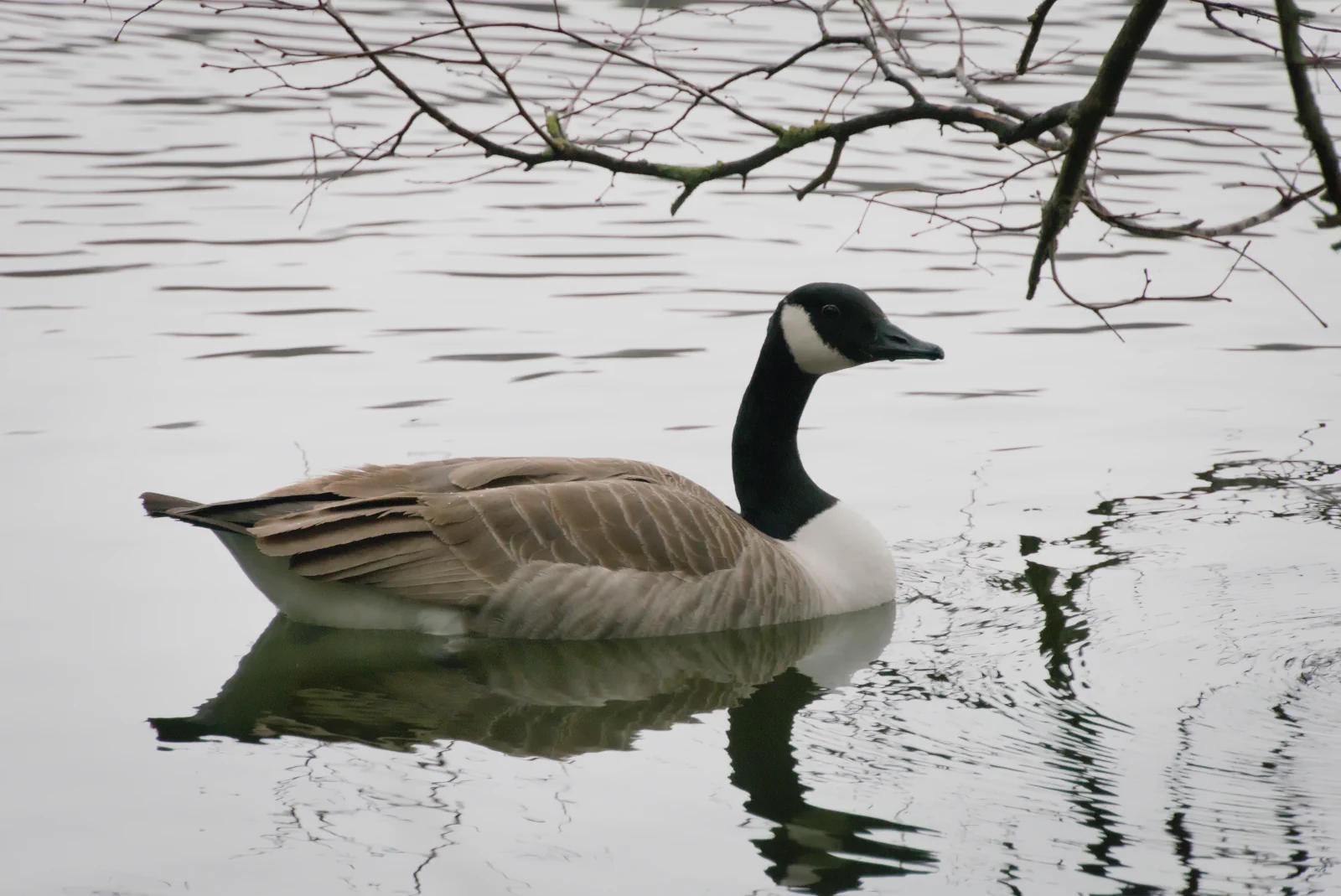
The Canada Goose is the largest of the anatids commonly encountered on French bodies of water. With its long black neck held high, the great white bandana-shaped patch beneath its chin, its sturdy brown body and massive silhouette, it resembles no other bird in Europe. Native to the North American continent, it was introduced to Western Europe for ornamental and hunting purposes (as early as the 17th century in England, then on a massive scale in the 20th century), before becoming permanently established in the wild. Today it can be found on ponds, lakes, slow-moving rivers, reservoirs, urban water bodies and ornamental basins, often in familiar, noisy flocks. The Canada Goose is a bird of open water and mown lawns, trusting of humans, which has found in our parks and agricultural plains a paradise without predators.
But behind this apparent confidence hides an anatid with ambiguous stakes. The Canada Goose is not merely "the big black-and-white goose of the parks": it is an accomplished migrant which, on its continent of origin, travels thousands of kilometres in V formations; a defensive mother whose protection of the nest is formidably vehement; a voracious herbivore whose grazing transforms the banks; and an introduced species whose expansion raises genuine ecological questions. Watching it means reflecting on the boundary between wild fauna and acclimatised fauna, and understanding that a familiar bird can also be a debated bird.
Classification
The Canada Goose belongs to the family Anatidae, which gathers ducks, geese and swans across the world (more than 170 species found on every continent except Antarctica). It is the best-known representative of the genus Branta, the so-called "black" geese (black-necked, as opposed to the grey geese of the genus Anser), which also includes the Brent Goose (Branta bernicla) and the Barnacle Goose (Branta leucopsis). The French name "bernache" would derive from an old distortion of "barnache", a word of Celtic origin denoting black geese. The scientific name canadensis recalls its North American origin. It is a herbivorous bird, tied to aquatic environments and grasslands: bodies of water, wet meadows, agricultural plains, parks and mudflats. Seven subspecies are recognised in North America, but the populations introduced in Europe derive mainly from the nominate subspecies Branta canadensis canadensis.
Identification
The Canada Goose is a very large anatid, the most imposing one can regularly encounter in Western Europe. Its length is approximately 90 to 110 cm, for a wingspan of 150 to 180 cm and a weight of 3,000 to 6,500 grams (males being noticeably heavier than females). Sexual dimorphism is slight and hardly visible in the field (the male is slightly larger and bulkier). The adult plumage is remarkably constant: the neck, head, chest and tail are black, with a large triangular white patch on the chin and throat (sometimes extending up to the cheek, an absolute diagnostic feature). The back and wings are grey-brown, the flanks paler brown finely vermiculated, the belly and undertail coverts white. The bill is black, the legs black. In flight, the silhouette is massive, the neck outstretched, wingbeats slow and ample, with a white rump clearly visible. Immatures resemble adults but are duller, with pale edgings on the back and a less distinct white throat patch. Confusion is possible with the Barnacle Goose (Branta leucopsis), but the latter is distinctly smaller, with a pale grey back and a white face mask. Confusion is also possible with the Cackling Goose (Branta hutchinsii), today considered a separate species and become extremely rare in Europe.
Songs and calls
The Canada Goose is a noisy bird, especially in flight and in flocks. The most typical call is a loud, nasal "ah-honk" or "ka-ronk", uttered in series of two or three syllables, in flight, when landing and during flock exchanges. This powerful call, given in chorus by birds flying in formation, carries far and is one of the most characteristic sounds of the water bodies frequented by the species. The alarm call is a repeated, urgent "honk". During the nesting period, the pair exchanges softer vocalisations, guttural murmurings during displays and nest reliefs. The young give high-pitched, insistent peeping calls to solicit their parents, and families remain very talkative throughout the rearing period. These calls can be heard several hundred metres away across the water and adjacent grasslands.
Habitat
The Canada Goose favours calm waters bordered by lawns or short grass, where it can feed on the ground within immediate reach of a possible escape to water. It is found on lakes, ponds, reservoirs, slow rivers, urban water bodies, golf courses, parks, ornamental basins and floodable agricultural plains. It requires two fundamental elements: a stretch of calm water for safety (night roosts, moulting, escape from predators) and lawns or grazing meadows with short, dense vegetation (cropping young, tender grass). Unlike native wild geese, which remain wary and confined to wide-open spaces, it tolerates perfectly the proximity of humans and man-made environments (urban parks, roadsides, developed banks). A water body with mown lawns and nesting islands can constitute suitable habitat. A pair's home range is small during the breeding season, but flocks wander over several kilometres outside the nesting period. In Europe, it is essentially sedentary, with local movements between nesting, moulting and wintering sites.
Behaviour
The Canada Goose is a gregarious, sociable bird, living in noisy flocks outside the nesting period (gatherings of several tens to hundreds of individuals can be seen at moulting and wintering sites). Its feeding behaviour is that of a terrestrial herbivore: it grazes the grass of lawns and meadows while walking slowly, head down, picking tender blades, and can spend long hours feeding on the banks. It also feeds in shallow water, up-ending like a duck or cropping submerged aquatic plants. It is very trusting towards humans in parks and frequented sites (it sometimes begs for food), but recently established populations or those descended from escapes remain warier. At nesting time, the pair becomes territorial and aggressive: the male fiercely defends the nest site, puffing up his plumage, hissing and charging on land as on water, against fellow geese as well as against walkers and dogs (a famous defensive behaviour that has earned the species a reputation for aggressiveness). Pairs are durably bonded (pair fidelity is maintained from year to year, the loss of a partner leading to the search for a new companion). Families stay together until the following breeding season. The Canada Goose is essentially sedentary in Europe, with local wandering (notably for moulting and wintering), and does not undertake the massive migrations characteristic of North American populations.
Flight
The Canada Goose's flight is powerful and heavy, yet sustained and enduring. It beats its wings at a slow, ample rate, with an audible beating sound carrying from afar (a characteristic muffled whoosh), in V formations or oblique lines during flock movements. The neck is stretched forward, the legs protrude slightly beyond the tail. Take-off is laborious: the bird must run across the water, flapping frantically over several metres before rising, splashing noisily. Once in flight, it crosses between water bodies and feeding grounds in low, direct flights, often calling. Daily movements (roosts, feeding flights) are short, but moulting and wintering flights can cover several tens of kilometres. On the water, it is often seen resting in families or dense groups at anchor, closing ranks for the night.
Feeding
The Canada Goose is an essentially terrestrial herbivore. Its diet is dominated by grasses: it grazes the turf of lawns, meadows and the edges of water bodies, favouring young, tender blades. It also eats leaves and shoots of herbaceous plants, submerged and floating aquatic plants, cereals in fields (wheat, maize, oilseed rape) and harvest leftovers on stubble, seeds, berries and acorns. In urban settings, it readily supplements its diet with bread thrown by walkers (an unsuitable food, which poses sanitary problems and encourages its sedentarisation) and seeds from bird feeders. It feeds by walking slowly on the ground, grazing methodically, or up-ends in shallow water to reach submerged vegetation. The young are fed grass and tender vegetation from their first days, supplemented by a few small aquatic invertebrates during their growth.
Breeding and nesting
Nesting begins early in spring (as soon as February-March, the Canada Goose being one of the first anatids to breed). The pair sets up its nest on the ground, on a bank, an island, a vegetation platform above the water or a floating island, often on a raised mound overlooking the surroundings. The nest is a bulky cup made of stacked stems, leaves and grasses, with a bowl lined with down as laying progresses. The nest site is often reused from one year to the next. The female usually lays 4 to 7 eggs, cream-white in colour. Incubation lasts about 25 to 28 days, carried out by the female alone, the male standing guard nearby and defending the territory vehemently. After hatching, the young are nidifugous: they leave the nest in less than 24 hours and follow their parents to the water, grazing almost immediately. Both parents protect the brood relentlessly (frontal attacks, hisses and blows of the wings against predators and intruders), the young taking wing after 8 to 10 weeks. One clutch per year is the rule, but a replacement clutch may occur after early failure. Sexual maturity is reached at around two to three years.
Distribution
The Canada Goose is native to North America, where it breeds from Canada to the United States and winters from the northern United States to Mexico. Its presence in Europe results from successive introductions (parks and private collections first, game restocking programmes afterwards), which led to permanent naturalisation from the 1950s-1970s onwards. It now breeds in Scandinavia, the British Isles, the Netherlands, Germany, Belgium, Switzerland, France and as far as central Europe, with European numbers estimated at several tens of thousands of pairs. In France, it breeds over much of the country (though unevenly distributed), with strongholds in Normandy, Île-de-France, Champagne, Lorraine, the Rhône valley and the South-West. The French population is estimated at a few thousand pairs, steadily increasing. The Canada Goose is therefore an introduced species, breeding and resident in France, present all year round on the water bodies and grasslands of many regions.
Threats and protection
The Canada Goose is classified as "Least Concern" (LC) by the IUCN worldwide, in its native North American range where populations are vast and stable. Its situation in Europe is different: it is an introduced species, which does not benefit from the protection granted to native birds. In France, it appears on the list of species that may be hunted (in the departments where prefectoral opening decrees have been issued) and has accordingly been part of the debates relating to invasive alien species. Its expansion indeed raises real stakes: competition with native anatids at nesting sites, overgrazing of reedbeds and banks (degradation of vegetation and marshland habitats, to the detriment of heritage species), eutrophication of water bodies by abundant droppings, occupation of mowing meadows, nuisance in parks and bathing areas, and sanitary risk (potential transmission of pathogens in recreational waters). Faced with these stakes, several European countries have undertaken population control campaigns (egg sterilisation, captures, culling), with varying results and ethical controversies. Managing the Canada Goose in France involves monitoring populations, appropriate regulation where densities cause problems, protecting sensitive wetlands from overgrazing, and raising public awareness (notably banning bread feeding, which encourages its concentration and sanitary imbalances).
Watching a Canada Goose means first being struck by scale: that disproportionate black neck emerging from the reeds, that white patch advancing towards you along the bank, that deep hiss of the male fixing you with its gaze while puffing out its chest — everything in this bird evokes quiet strength and confidence. In parks, it grazes the grass amid the walkers, indifferent to pushchairs and dogs, grumbling among its fellows like an assembly of notables. In spring, the spectacle changes tone: families cross the water in proud processions, the mother at the head, the father as rearguard, the yellow-grey goslings lined up between them, each watching over its offspring with admirable (and sometimes formidable, for anyone approaching the nest a little too closely) determination. But what strikes most is the vertigo of history: this goose that seems to have always populated our landscapes was not living here two centuries ago. Come from the great North American migrations via the aviary and the trade in birds, it settled, acclimatised, naturalised itself, to the point that one would believe it indigenous. Where it settles in numbers, the reedbeds suffer, the banks erode, the water bodies grow richer in nutrients, and the naturalist finds himself facing a question with no simple answer: what should be done with a beautiful wild creature grown too numerous? Behind its black neck, its white bandana and its resonant honks, the Canada Goose remains a bird of paradoxes (majestic yet invasive, familiar yet wary in its homeland, admired yet regulated), whose presence reminds us that yesterday's introductions shape today's landscapes. And every flock that lifts off in formation towards the dusk meadows is a questioning: that of a fauna reshuffled by humans, which we must learn to know, to manage and sometimes to contain, with as much rigour as we devote to protecting the species that were promised to us.