

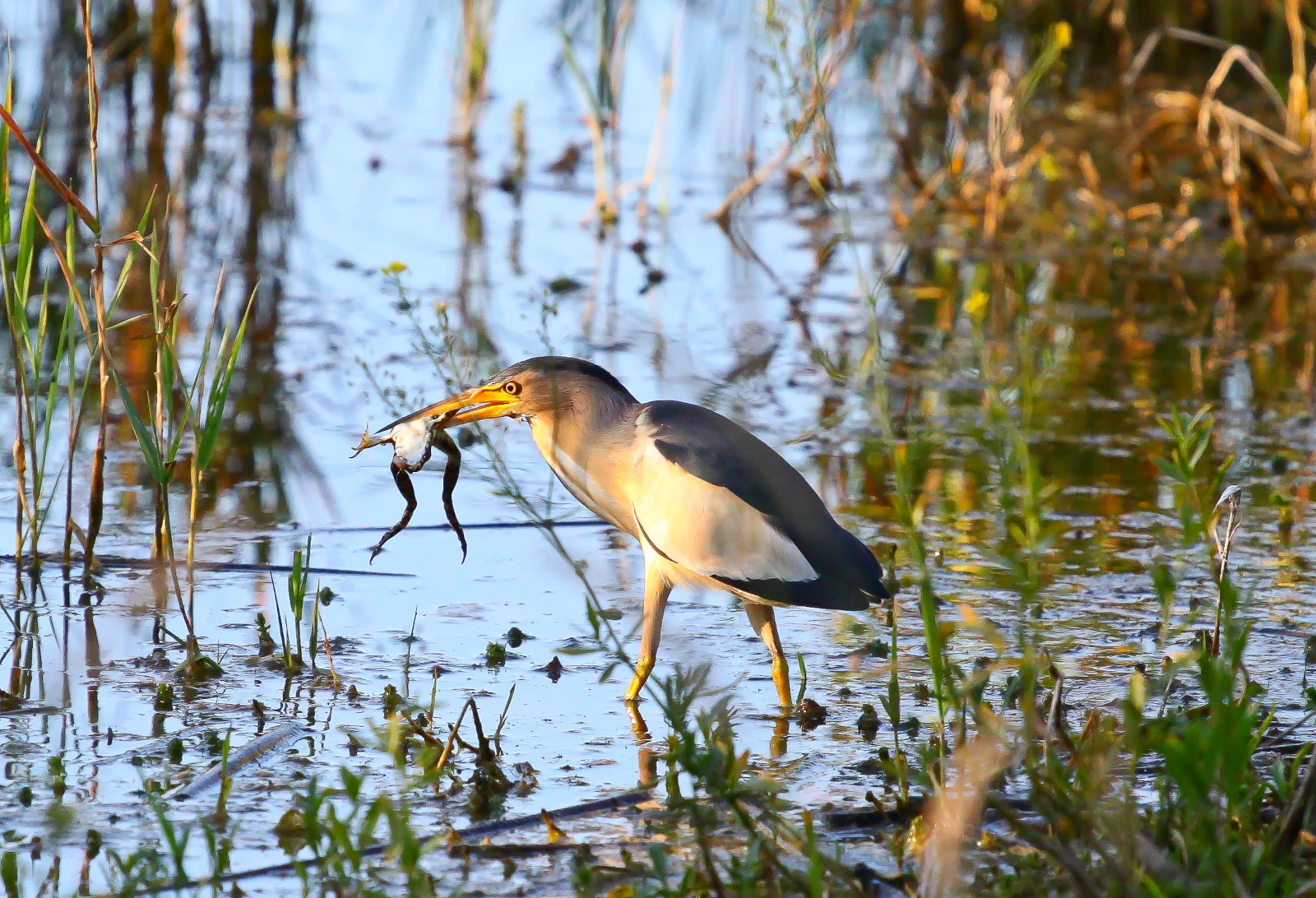
The Little Bittern is the smallest heron in Europe, and certainly one of the most secretive. Far from the stately elegance of the Great Egrets or the familiarity of the Grey Heron, it is a miniature bird of the reedbed, built to melt into the reeds. It takes patience and a trained eye to track one down: motionless among the stems, bill pointed skyward, it blends into the vegetation until it almost disappears entirely.
Yet behind this retiring profile hides an ardeid full of character, quick in its movements, patient in its stalking, and capable of feats of camouflage that make it unique among herons. The Little Bittern embodies another dimension of wetlands, the one experienced at reed level, in the hidden heart of the stands where light barely filters through.
Classification
The Little Bittern belongs to the family Ardeidae, which includes herons, egrets, bitterns and the smaller bitterns known as blongios. It is the smallest representative of this family in Eurasia and Africa. Within the genus Ixobrychus, its close relatives include the Cinnamon Bittern (Ixobrychus cinnamomeus) and the Yellow Bittern (Ixobrychus sinensis), both found in Asia. It is a bird closely tied to reedbeds and the dense waterside vegetation bordering shallow, calm freshwater.
Identification
The Little Bittern is a compact, stocky bird, measuring about 30 to 38 cm in length, with a wingspan of 52 to 63 cm and a weight of 140 to 160 grams. Its silhouette is typical of small herons: a relatively short neck, a chunky body, a pointed bill and rather stiff tail feathers. The adult male is distinguished by a striking contrast: the back, crown and tail are slate black with greenish sheens, while the neck, breast and belly are a warm buff-tan. The sides of the neck bear a longitudinal black band running from the throat down to the breast. The wings show a large pale, cream-coloured patch, clearly visible in flight. The bill is yellowish, the legs greenish-yellow and the irises yellow. The female is duller and more heavily streaked: her back is blackish-brown spotted with buff, her breast is longitudinally striped with brown, and her overall coloration tends more towards reddish brown. This sexual dimorphism is marked and makes identification fairly straightforward when the plumages can be distinguished. Immatures resemble the female with an even more heavily streaked rufous-brown plumage, a more reddish back and a generally duller appearance. They can be confused with the Cinnamon Bittern, but that species does not breed in the Western Palearctic. One very useful behavioural identification clue: when surprised, the Little Bittern adopts a posture of absolute stillness, neck stretched skyward, bill pointing vertically. This attitude, known as the "bittern posture", allows it to blend in with the surrounding reeds, sometimes even swaying slightly in rhythm with the wind in the vegetation.
Songs and calls
The Little Bittern is mostly vocal at dusk and dawn, when most of its feeding and territorial contact activity takes place. Its main song, delivered by the male from within the reedbed, is a deep, repetitive "hoo... hoohoo", guttural and muffled, reminiscent of a felt-covered hammer striking an anvil. This characteristic sound carries far across the reeds, particularly in the calm of a summer evening. It is repeated every 2 to 3 seconds, sometimes for many minutes at a time. The female gives a guttural "graaa", deeper and shorter, sometimes heard during exchanges at the nest or in response to the male's song. When flushed or startled, the bird utters a hoarse, sharp call, a brief "kark" or "kraak", particularly audible as it escapes low over the reeds. Young birds at the nest give high-pitched, repetitive calls, a kind of guttural chirping, to beg for food from their parents.
Habitat
The Little Bittern favours calm, shallow freshwater bordered by tall, dense reedbeds. It is found in marshes, reed-fringed ponds, coastal lakes, slow-flowing rivers with vegetated banks, wide ditches and flooded former gravel pits reclaimed by vegetation. The key element of its habitat is the presence of a well-developed reedbed, composed of common reeds (Phragmites australis) but also bulrushes (Typha spp.), sedges and other emergent plants. It seeks out dense, continuous stands, extensive enough to provide protected nesting sites and areas for lying in wait. A reedbed of at least a few hundred square metres is needed to hold a breeding pair. It avoids open water with no shoreline vegetation, salt water, fragmented or trampled reedbeds, and areas where water management causes abrupt fluctuations in water level. The immediate proximity of open water within the reedbed is important: it uses channels and gaps to feed. Unlike the Great Bittern, which uses deep, inaccessible reedbeds, the Little Bittern accepts smaller and more fragmented reedbeds, which means it can sometimes be present even in peri-urban areas where tranquillity is assured.
Behaviour
The Little Bittern is essentially a crepuscular and nocturnal bird, even more secretive than the Great Bittern. During the day it stays tucked away in the reeds, motionless or nearly invisible, and makes itself known only through its song at dusk. Its activity peaks at dawn and nightfall, when it leaves its hiding post to reach the channels and edges of open water in search of food. Its main defensive strategy relies on camouflage and stillness. When it senses it is being watched, it stretches its neck, points its bill at the sky and freezes, merging with the reeds. If the threat persists, it takes flight with a low, brief and furtive flight, diving back into the vegetation a few metres further on. Outside the breeding season it is a solitary bird. The breeding territory is defended mainly by song rather than by direct confrontation, although short chases may occur at territorial boundaries. The male sings from an elevated perch within the reeds, sometimes from the top of a stem.
Flight
The Little Bittern's flight is fast, direct and low, usually barely above the vegetation or the water. Wingbeats are quick and regular, with brief pauses. Its silhouette in flight, compact, recalls that of a rail or a small pale hawk, with rounded wings and the large cream patch clearly visible. Take-off is sudden, without a preliminary run: it tears out of the reeds with a single beat of the wings, unlike the Grey Heron or the Great Egret, which laboriously gather momentum before lifting off. This reflects its agility and its adaptation to the cramped spaces of the reedbed. On migration, its flight becomes higher and more sustained, mainly nocturnal. It is this discreet, largely night-time mode of travel that explains why the Little Bittern so often escapes observation on its journeys: it is discovered on arrival, perched in a reedbed, rather than seen in transit.
Feeding
The Little Bittern feeds by lying in wait or moving slowly along the channels, at the edge of the reeds and on mats of floating vegetation. It hunts from ambush, motionless, neck retracted, then suddenly thrusts its bill forward to seize its prey. Its diet is varied but dominated by small aquatic animals: insects and their larvae (dragonflies, diving beetles, caddisflies), small fish, tadpoles and amphibians, freshwater crustaceans, worms and molluscs. It can also catch small terrestrial prey in the vegetation: grasshoppers, spiders, snails. Unlike the larger herons, it does not take large prey. Its technique is to swallow prey on the spot, sometimes after turning it around or stunning it with a blow of the bill against a stem. The young are fed by regurgitation: the parents bring a partially digested mush of small fish and insects, most often at the nest and during the first hours of the day.
Breeding and nesting
Nesting begins in spring, usually between May and June depending on latitude and local conditions. The male generally arrives before the female at the breeding sites, defines his territory through song and attracts the female. The nest is built in the reedbed, at low height (20 to 50 cm above the water), anchored between reed or bulrush stems. It is a crude platform of broken stems and leaves, with a shallow cup. It is often situated above shallow water, well concealed within the density of the vegetation. The female lays 5 to 7 eggs, pale greenish-white in colour, unspotted. Incubation lasts about 17 to 19 days, carried out by both parents in turn. After hatching, the young are nidicolous: they remain at the nest for several days, fed by both parents. They grow quickly and can leave the nest at around 10 to 12 days of age by climbing through the reeds, but do not truly fledge until about 25 to 30 days. The parents continue to feed them for some time after fledging. A second clutch is possible, particularly in the southern part of the range, if the first succeeds early in the season.
Distribution
The Little Bittern has a wide range covering Europe, western and central Asia, and Africa. In Europe, it is found from the Iberian Peninsula and France to the Asian steppes, reaching southern Scandinavia and the Baltic in the north. It is generally more abundant in the Mediterranean regions and the southern half of Europe. In France, it breeds in most lowland regions with suitable reedbeds: the Camargue, the Dombes, the Brenne, the Marais poitevin, Languedoc, Corsica, the Landes lakes and the Atlantic marshes. It is more localised and more sporadic in the north and east, where high-quality reedbeds are scarce. The species is wholly migratory in Europe: all individuals leave the continent in autumn to winter in sub-Saharan Africa, mainly in the wetlands of the Sahel and tropical regions. The return takes place in April-May, often discreet and gradual.
Threats and protection
The Little Bittern is classified as "Least Concern" (LC) by the IUCN globally, but its European populations show a marked decline in several countries, including France, where it appears on several regional red lists as vulnerable or near threatened. The main threat weighing on the species is the destruction and degradation of reedbeds. The drainage of wetlands, the drying out of marshes, the conversion of ponds into farmland or building land, as well as excessive mechanical management of reeds, reduce the available nesting sites. The fragmentation of reedbeds isolates pairs, limits exchanges between populations and compromises the long-term viability of local colonies. Human disturbance, notably from water-based leisure activities (water skiing, powerboating, fishing from boats close to nests), causes nest abandonment and breeding failure. Predation by brown rats, corvids and opportunistic terrestrial mammals affects nests and young. Climate change, by altering precipitation patterns and water levels in wetlands, could affect the availability of nesting habitat in the medium term. Drought in the Sahel, the species' wintering area, is also a worrying factor for migratory populations. Protecting the Little Bittern requires the conservation and restoration of extensive, functional reedbeds, careful water-level management in marshes, limiting boat traffic during the nesting season, and maintaining ecological corridors connecting wetlands to one another. Extensive, differentiated management of reedbeds (late mowing on a rotational basis, preservation of unharvested stands) is one of the most effective measures in favour of this species.
Watching for a Little Bittern means accepting to listen intently at dusk, to wait a long time in the silence of the reeds, and to understand that some birds simply do not give themselves away. It is there, in the stand of Phragmites, almost within binocular range, but it merges with the stems, sways imperceptibly, stares back at you with its yellow eye and remains unseen. It is a bird that teaches patience and rewards attentiveness. Its presence is a precious indicator: it means there is still a living reedbed, dense enough and quiet enough to shelter one of the most demanding and most fragile of our European herons. Behind its small size, its camouflage and its discretion, the Little Bittern reminds us that the most ordinary wetlands (a village pond, a rural marsh, a roadside ditch) can harbour treasures of biodiversity. Provided, that is, we know how to see them, hear them, and above all, protect them.