

The Great Tit is undoubtedly one of the most familiar garden birds and one of the easiest to identify. With its black head, white cheeks and yellow belly barred by a black stripe, it looks like a small passerine that never goes unnoticed. It turns up at feeders as soon as autumn arrives, nests in boxes come spring, and is found wherever a hedge, a hollow tree or a shrub bed offers it a corner of life.
Yet behind its bold colours and familiar build lies a remarkably resourceful bird. The Great Tit is not merely "the yellow-and-black bird of the garden": it is an adaptable, opportunistic, curious species, sometimes even aggressive when defending a nesting cavity. Watching it means discovering the richness of a bird that lives within arm's reach while retaining every ounce of its wild nature.
Classification
Order: Passeriformes
Family: Paridae
Genus: Parus
Species: Parus major
The Great Tit belongs to the family Paridae, which includes tits such as the Great Tit, Blue Tit, Coal Tit, Marsh Tit, Crested Tit and Willow Tit. It is the largest and one of the best-known of our European tits. It is an opportunistic insectivorous and granivorous bird, closely associated with both woodland environments and parks and gardens.
Identification
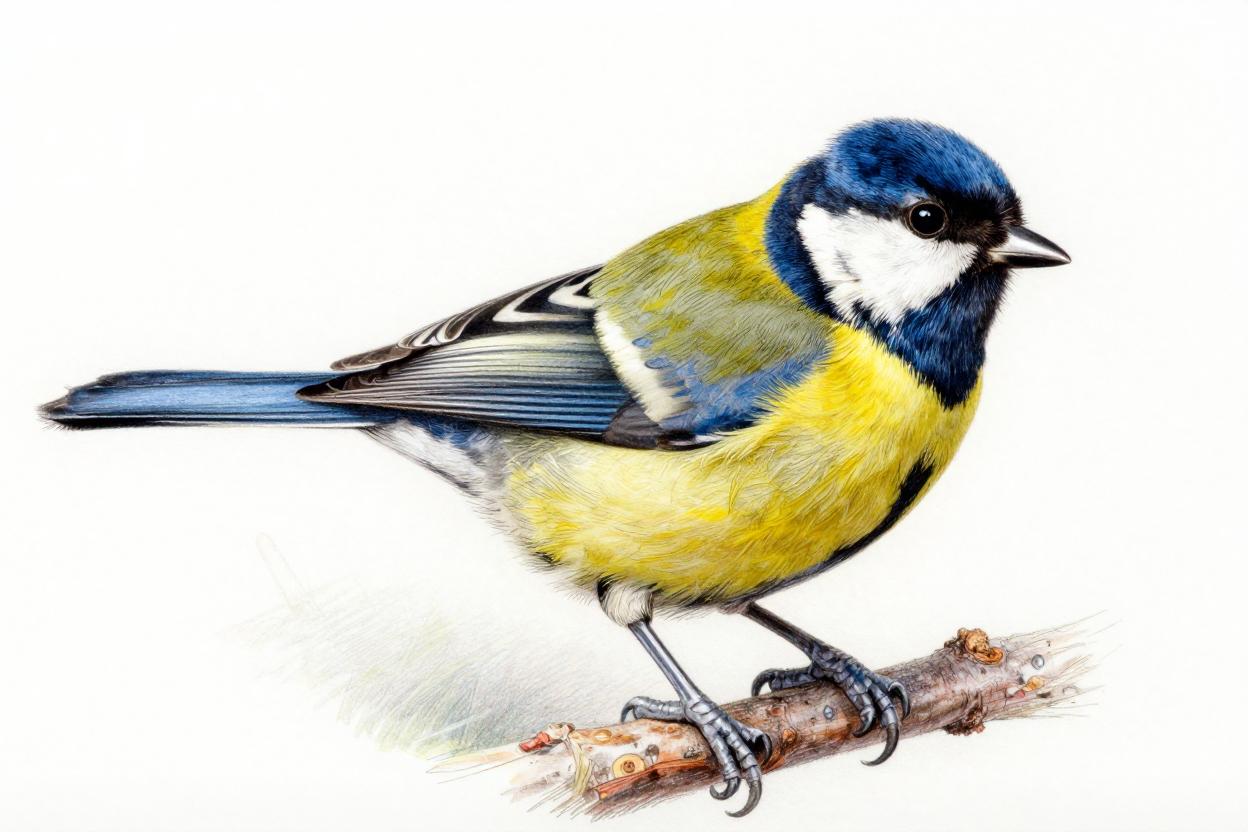
The Great Tit is a stocky passerine with a rather rounded silhouette, a large head and a short, sturdy bill. Its identification features are among the clearest of any garden bird: the head is black, with large contrasting white cheeks; the back is greenish, tinged with olive; the belly is bright yellow, marked by a broad black longitudinal stripe known as the "tie", running from the throat down to the belly.
This black stripe is wider and more pronounced in males than in females, where it appears narrower and sometimes broken. It is one of the few elements allowing the sexes to be distinguished in the field, though it requires some practice and a good view.
Juveniles have duller plumage: the cheeks are yellowish rather than pure white, the black of the head is less contrasting and the tie is absent or very faint. They are mostly recognised by their begging posture towards adults in summer.
Songs and calls
The Great Tit has one of the most recognisable voices in our gardens and woodlands. Its characteristic song is a rhythmic, repetitive series, often transcribed as "ti-ti-tu, ti-ti-tu, ti-ti-tu" or "tsu-dsu-du". It is a lively, loud song that marks the onset of spring and may continue throughout the year in mild weather.
It possesses an extensive vocal repertoire for such a small bird. Its most frequent call is a sharp, ringing "tchink" or "tsi-ti-ti", sometimes delivered in a series when excited or alarmed. A hoarse "tchirrp" is also heard when the bird is uneasy.
During territorial disputes over a nesting cavity, it can produce an intense, continuous chattering, a kind of nervous buzzing that accompanies stand-offs between contenders. It is a very distinctive sound, almost "electric", inevitably associated with the month of March.
Habitat
The Great Tit thrives in a wide variety of habitats, provided there are trees and cavities. It is found in deciduous forests, mixed woodlands, urban parks, gardens, orchards, riparian corridors, tree-lined avenues and even village copses.
It requires cavities for nesting: a tree hole, a wall crevice, an old woodpecker nest and, of course, artificial nest boxes. It is one of the species that most readily adopts nest boxes, making it an excellent subject for observation and public engagement.
Conversely, it avoids overly open, treeless environments: intensive farmland, close-mown lawns with no shrub layer. A garden with a few fruit trees, a varied hedge and a well-placed nest box can host it on a long-term basis.
In winter, it regularly visits feeders, where it can be dominant over other tits and small passerines, its size giving it a degree of authority.
Behaviour
The Great Tit is a lively, curious and restless bird. It hops along branches, inspects bark, turns over leaves and explores every nook and cranny. It rarely stays still for long, except when scanning its surroundings from a perch.
Outside the breeding season, it is a social species. In autumn and winter, it readily joins mixed flocks that may include Blue Tits, Coal Tits, occasionally Marsh Tits or Crested Tits, as well as goldcrests. These troops move together through woods and hedgerows, each species occupying a slightly different stratum or foraging technique.
At the feeder, the hierarchy is visible: the larger Great Tit often takes precedence and pushes aside smaller tits. It can be assertive but rarely violent. It grabs a seed, carries it to a nearby branch and holds it underfoot to hammer it open with precise blows of the bill.
It is also a territorial species during the breeding season: the male defends the area around the nest, patrols while singing, and may engage in vocal stand-offs with neighbours or competitors for a cavity.
Flight
The Great Tit's flight is undulating, typical of tits: a series of rapid wingbeats followed by a brief folding of the wings, producing a gently rolling profile. It is a short, low flight, most often between a tree and a hedge, a perch and a feeder, a branch and the ground.
It does not undertake sustained long-distance flights, except during seasonal movements or post-breeding dispersal. In the garden, it is detected as much by its constant calls and ceaseless coming and going around feeders or cavities as by its flight itself.
Diet
The Great Tit has an opportunistic and varied diet. During the breeding season, it feeds primarily on insects and their larvae, caterpillars, spiders, small beetles and other invertebrates. It is a valuable ally to the gardener: an active pair can capture hundreds of caterpillars within a few days to feed its brood.
In autumn and winter, it shifts towards seeds (sunflower, hemp, fat balls), fruit, berries and even fragments of meat or suet found at feeders. It also drinks sap flowing from bark wounds in spring.
In the garden, it readily visits hanging feeders, fat balls and peanut dispensers. But it also forages naturally: bark, branches, leaf litter, wall cracks. It is a bird that exploits every stratum, from the ground to the canopy.
Breeding and nesting
Nesting begins early, often as soon as March. The female selects a cavity (a natural tree hole, an old woodpecker lodge, an artificial box) and builds a nest of moss, dry grass and hair, lined with fine fibres and feathers. Nests are sometimes placed in surprising locations: letterboxes, pipes, wall cavities, balcony nest boxes.
The female typically lays 5 to 12 eggs, making it a species with strong reproductive capacity. Incubation lasts approximately thirteen to fifteen days and is carried out by the female, who is fed by the male during this period. After hatching, both parents work intensively to feed the young, which remain in the nest for about twenty days before fledging.
The young leave the nest still clumsy and remain hidden in surrounding foliage or bushes for several days, being fed and supervised by the adults. As with the robin, it is important not to "rescue" a young tit found on the ground too hastily: if the parents are nearby, it is better to place it out of immediate danger (cat, road) and leave it with its family.
A second clutch is common during the season, particularly if the first was successful.
Distribution
The Great Tit is one of the most widespread birds in Eurasia. It is found from the Atlantic to the Pacific, from the Arctic Circle to the edge of the subtropics. In Europe, it occurs everywhere, from large cities to the most remote forests.
In France, it is common across the entire territory, from urban gardens to mountain forests. It is one of the most frequently recorded species in citizen science programmes such as garden bird counts.
It is essentially sedentary. However, post-breeding dispersal may lead juveniles to travel several kilometres, and in autumn some northern populations undertake modest migrations.
Threats and conservation
The Great Tit remains a common and dynamic species. However, it depends on the availability of nesting cavities and on the abundance of insects during the chick-rearing period.
Landscape simplification, the loss of old trees and hedgerows, agricultural intensification and pesticide use indirectly affect its resources. Competition for natural cavities, particularly with invasive species such as the Common Starling, can reduce nesting opportunities where sites are limited.
Predation by domestic cats remains a pressure factor, especially for fledglings. Window collisions are also observed, the Great Tit sometimes being attracted by its own reflection or by vegetation visible through the glass.
Supporting the Great Tit involves simple actions: installing suitable nest boxes (entrance hole 28–32 mm), preserving old hollow trees, maintaining a varied hedge, avoiding pesticides and offering supplementary food in winter without excess or dependency. Protecting caterpillars means protecting the vital resource of the breeding season.
Going further
Watching a Great Tit means watching one of the most efficient birds of our gardens at work. It bridges wildness and familiarity: it is found in the deepest woods as well as on a city balcony ledge. It nests in an old oak just as easily as in a letterbox; it sings from the highest branch just as it pecks at a suspended peanut.
It quietly embodies an age-old relationship between humans and familiar birds: the one that consists in putting up a nest box, hanging a feeder, accepting that a patch of territory might be shared. Wherever it thrives, there are trees, cavities, insects in spring, seeds in winter, and that gentle living untidiness that welcoming gardens know how to preserve.
Behind its confidence, its tie and its white cheeks, the Great Tit remains a bird of character (curious, vocal, opportunistic) whose constant presence reminds us that ordinary biodiversity deserves as much attention as the rarest of species.