

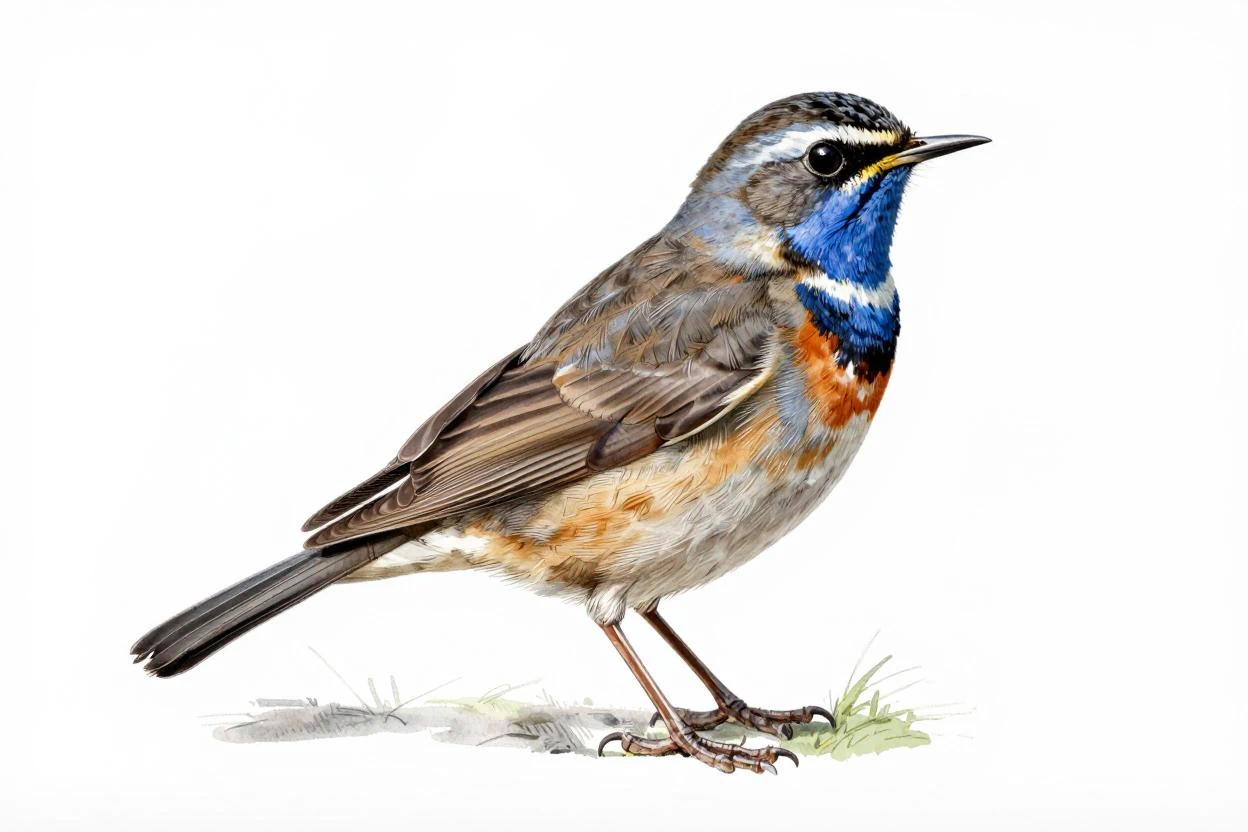
The Bluethroat is one of those birds that rewards the patience of the observer. Discreet, fond of dense vegetation cover, it rarely shows itself in the open. But when it deigns to perch on a reed or low branch, its plumage surprises: a bright blue throat, bordered by black, white and rufous, adorned with a central "mirror" whose color varies by subspecies (white or rufous) and which gives its name to the bird. It is a brief spectacle, often morning or twilight, but unforgettable.
But behind this singular plumage hides a cunning and secretive passerine, tied to wetland environments. The Bluethroat is not just "the blue-throated bird of marshes": it is a migratory species, shy, with rich and varied vocalizations, capable of imitating other birds and singing in night darkness. Observing it means accepting the constraint of reeds, mist and patience, and discovering a bird that combines discretion and beauty.
Classification
- Order: Passeriformes
- Family: Muscicapidae
- Genus: Luscinia
- Species: Luscinia svecica
The Bluethroat belongs to the family Muscicapidae, which includes notably the bluethroats, robins, nightingales and wheatears. Formerly classified among Turdidae, it is now integrated into Muscicapidae following recent taxonomic revisions. It is an insectivorous migratory bird, closely linked to wetland environments: reedbeds, marshes, floodplain meadows, riverbanks and peat bogs. Several subspecies are recognized, of which two mainly concern Western Europe: Luscinia svecica cyanecula, with white mirror, which nests in France, and Luscinia svecica svecica, with rufous mirror, breeding in Scandinavian arctic regions and observed during migration on our territory.
Identification
The Bluethroat is a small passerine, the size of a redstart or slightly larger, stocky and rounded, with an appearance close to the European Robin but more contrasting. Its length is approximately 13 to 14 cm, with a modest wingspan.
The major identification criterion is obviously the blue throat of the adult male, framed by a narrow black band then a rufous edging. At the center of this blue distinguishes a "mirror" (a lighter and contrasting patch) which can be white (subspecies cyanecula) or rufous (svecica). This pattern is unique among our passerines and causes little confusion when visible.
The rest of the plumage is more discreet: upperparts are brown-olive, underparts are pale with breast tinged rufous, and the tail presents a characteristic rufous base, often visible when the bird briefly raises it after settling. This "rufous flash" is an excellent recognition criterion in flight or at distance, even when the throat is not visible.
The female is much duller: she lacks the blue throat, but a dark collar may suggest the male's pattern. She is recognized mainly by the rufous base of the tail, brown-olive body above and pale below, with whitish throat sometimes slightly streaked. Young birds are spotted, resembling a juvenile robin, but retain the rufous patch at the tail base.
Distinction between males and females is clear in adults, but identification during migration can remain tricky when the bird flees at reed level: we then catch only a rufous flash and a furtive silhouette.
Songs and Calls
The song of the Bluethroat is one of the great surprises of our wetlands. It is composed of a soft introduction, sometimes almost whispered, followed by a rise in power and a final brilliant and sonorous phrase. We hear imitations of other species (Blackbird, Swallow, Redstart, Nightingale) mixed with crystalline notes and specific trills. It is a surprisingly powerful song for such a small bird, carried far above the reeds.
This song is typically emitted from an exposed perch (reed top, dry branch, emerging bush) at dawn, dusk, and sometimes in full night. Nocturnal singing is a notable trait of the species, particularly during migration and nesting period. It is not uncommon to hear a Bluethroat sing in the middle of the night in a reedbed in May, when no other bird makes itself heard.
The male sings to delimit his territory and attract a partner. The repertoire can vary between individuals and include highly elaborate imitation sequences, making the song sometimes difficult to attribute at first glance.
The calls of the Bluethroat are more sober: a dry and brief "tuck", emitted in flight or at perch when the bird is alarmed. We also hear a rough and rolled "chrrret", harder, when alarm rises. This contact call, emitted moving through vegetation, is often the first indication of the species' presence before any visual observation.
Habitat
The Bluethroat prefers wetland environments rich in dense and structured vegetation. We find it in reedbeds, marshes with sedges and phragmites, wet meadows scattered with bushes, peat bogs, sedge marshes, pond shores colonized by palustrine vegetation, slow-flowing river banks and flooded ditches bordered by willows.
It needs low and dense vegetation cover to nest on the ground, or very near ground, and a tall herbaceous layer (reeds, sedges, large grasses) to move under cover. The presence of bushes or emerging perches is important for territorial singing.
It avoids dry, open environments devoid of dense vegetation: intensive fields, bare lawns, urbanized areas without wetlands. An maintained marsh, managed reedbed, floodplain meadow with some willows can constitute adequate territory.
During migration, it stops in any type of suitable wetland: coastal marshes, stabilization ponds, decantation basins, lagoons, salt marshes. It is often during these migratory stopovers that it is observed outside its nesting quarters.
Behavior
The Bluethroat is a shy, discrete bird, spending most of its time hidden in vegetation. It moves by gliding between reed stems, flutters at canopy level, and exposes itself only briefly, most often to sing or survey surroundings from a perch. This discretion is constitutive of its behavior: one can hear a Bluethroat for hours without ever seeing it.
It is a solitary species during nesting period. The male defends a territory he marks by song, sometimes by short singing flights above vegetation. Confrontations between males happen mainly through voice: parallel songs, power rises, a few brief chases. Physical contacts are rare.
During migration, the Bluethroat travels alone. It does not form groups, but several individuals can simultaneously gather in a favorable wetland zone, each exploiting its own sector. It is then silent, or emits only discrete contact calls.
It is active at dawn and dusk. Daytime activity exists but remains more discreet: food search in low vegetation, dusting on ground, short movements between perches and feeding areas. Its environmental exploitation is methodical, detailed, often invisible from outside.
Flight
The Bluethroat's flight is fast, direct and low. It flies between reeds, in one stroke, with rapid wing beats and often curved trajectory. It is a flee and short displacement flight, typical of a bird living in cover: we see few sustained flights, few high flights, except during male's courtship singing flights or migratory displacements.
When it takes off, it often reveals the rufous base of its tail, which snaps briefly at rest (a characteristic gesture, comparable to the Robin raising its tail. This rufous flash allows most often to signal it in observation when detailed plumage is not discernible).
During migration, its flight becomes higher and more sustained, essentially nocturnal. That's why the Bluethroat is rarely observed during active migration: we discover it perched, at dawn, in a wetland stopover site.
Feeding
The Bluethroat feeds primarily on invertebrates: insects and their larvae, beetles, dipterans, caterpillars, spiders, small mollusks, freshwater crustaceans, worms. It searches for food on ground, in humid litter, between reed stems, on exposed mud, and sometimes on low leaves.
During nesting period, caterpillars and various larvae constitute the main menu for young. The female transports prey to the nest hidden in vegetation, and waste is removed to keep the nest clean.
In autumn and winter, it diversifies its diet towards small berries and seeds available in wetland environments. On African wintering grounds, it consumes a more varied part of terrestrial and aquatic invertebrates.
Its hunting method is patient and methodical: it explores soil and low vegetation, pecks, turns debris, inspects stems. It can also capture prey in short flight, jumping from a low perch.
Reproduction and Nesting
Nesting begins in spring, often from late April or May depending on latitude and local conditions. The nest is built on ground or very near ground, hidden in dense vegetation — sedge tussock, reed base, bank hollow. It is a cup of dried grass, leaves and vegetable fibers, lined with finer materials.
The female lays generally 4 to 7 eggs. Incubation lasts approximately thirteen to fourteen days, assured principally by the female. After hatching, both parents participate in feeding. Young leave the nest after about twelve to fourteen days, still awkward, and remain hidden in neighboring vegetation, fed by adults for several more days.
Nesting success depends closely on site discretion, water level stability and vegetation cover density. Late flooding, premature mowing or trampling can annihilate a clutch. A second brood is possible during the season, particularly if the first succeeded.
As with the Robin, young on ground in post-fledging phase should not be "saved" too hastily: if parents are present, we must leave them near the family.
Distribution
The Bluethroat has a vast range, covering much of Eurasia, from northern Europe to Russian Far East, and from Scandinavian arctic to Central Asian mountains. In Europe, it distributes according to several subspecies: cyanecula (white mirror) nests in central and western Europe, svecica (rufous mirror) in northern Scandinavia, and other subspecies occupy the eastern continent.
In France, the regular nesting subspecies is Luscinia svecica cyanecula. Its nesting is localized, often fragmented, concentrated in large marshes, alluvial valleys and maintained wetlands. France lies at the western limit of cyanecula's nesting range, which makes French populations vulnerable and precious.
The Bluethroat is a trans-Saharan migrant. European populations winter mainly in tropical Africa. Migratory returns are observed from late March and April; departures occur in August and September. The subspecies svecica (rufous mirror) is observed during passage migration in France, mainly on coastal wetland zones.
Threats and Protection
The Bluethroat remains locally threatened in several Western European countries, due to fragmentation and degradation of its wetland habitats. Drainage of marshes, drying of floodplain meadows, urbanization of watercourse banks and agricultural intensification reduce surfaces available for nesting.
Extensive pastoral management, reasoned grazing of wetlands, maintenance of mosaic of reedbeds and sedge marshes, and water level regulation are favorable to the species. Conversely, early mowing of wet meadows can destroy broods, and spontaneous woody colonization of marshes, if not controlled, closes environments and makes them unsuitable.
Predation by domestic and stray cats can exert local pressure on nesting and migratory populations. Collisions against human structures (windows, cables) are observed anecdotically.
Protection of the Bluethroat passes through simple but demanding measures: preserve functional wetlands, avoid drainage, maintain structured palustrine vegetation, practice pastoral management or late mowing respectful of ground nesting, and monitor chemical water quality. Favoring ecological corridors between marshes, wet meadows and valleys, is allowing the species to reclaim abandoned territories.
For Further Reading
Observing a Bluethroat means accepting patience and fragility of the moment. It does not give itself easily: one must watch at dawn, listen closely in reeds, guess its presence from a brief cry and rufous flash between stems. But when the male finally shows, perched on reed top, throat offered to rising sun, it is a suspended moment, almost unreal.
It embodies the discreet beauty of wetlands: this fragile in-between where water and earth meet, where reeds slow the gaze and where life flourishes provided we preserve it. Where it thrives, there are maintained marshes, floodplain meadows, clean waters, abundant insects and this dense vegetation that says no to development and yes to biodiversity.
Behind its blue throat, its mirror and legendary discretion, the Bluethroat remains a bird of contrasts (shy but sonorous, hidden but spectacular, rare but faithful to its sites), whose fragile presence reminds us that wetlands deserve particular vigilance and that certain treasures reveal themselves only to patience.