

Warning: what follows may trigger, in some students, a sudden urge to stare out the window (but for good reasons). Because ESD isn’t a green punishment, nor a collection of “good habits” to recite between two multiplication tables. It’s an investigation: learning to notice the living world (even in a schoolyard made of asphalt), to ask the kind of questions that scratch, to check rather than simply believe, and to act without imagining yourself responsible for the state of the planet (they already bear the responsibility of the marker drying out without its cap). In short: a compass for growing up in a changing world… without losing your bearings or your blackbird.
Reader advisory: this piece contains traces of leaves, a pinch of common blackbird, and a high probability of students asking impossible questions at 9:03 a.m.
Opening scene (in an ordinary classroom)
-
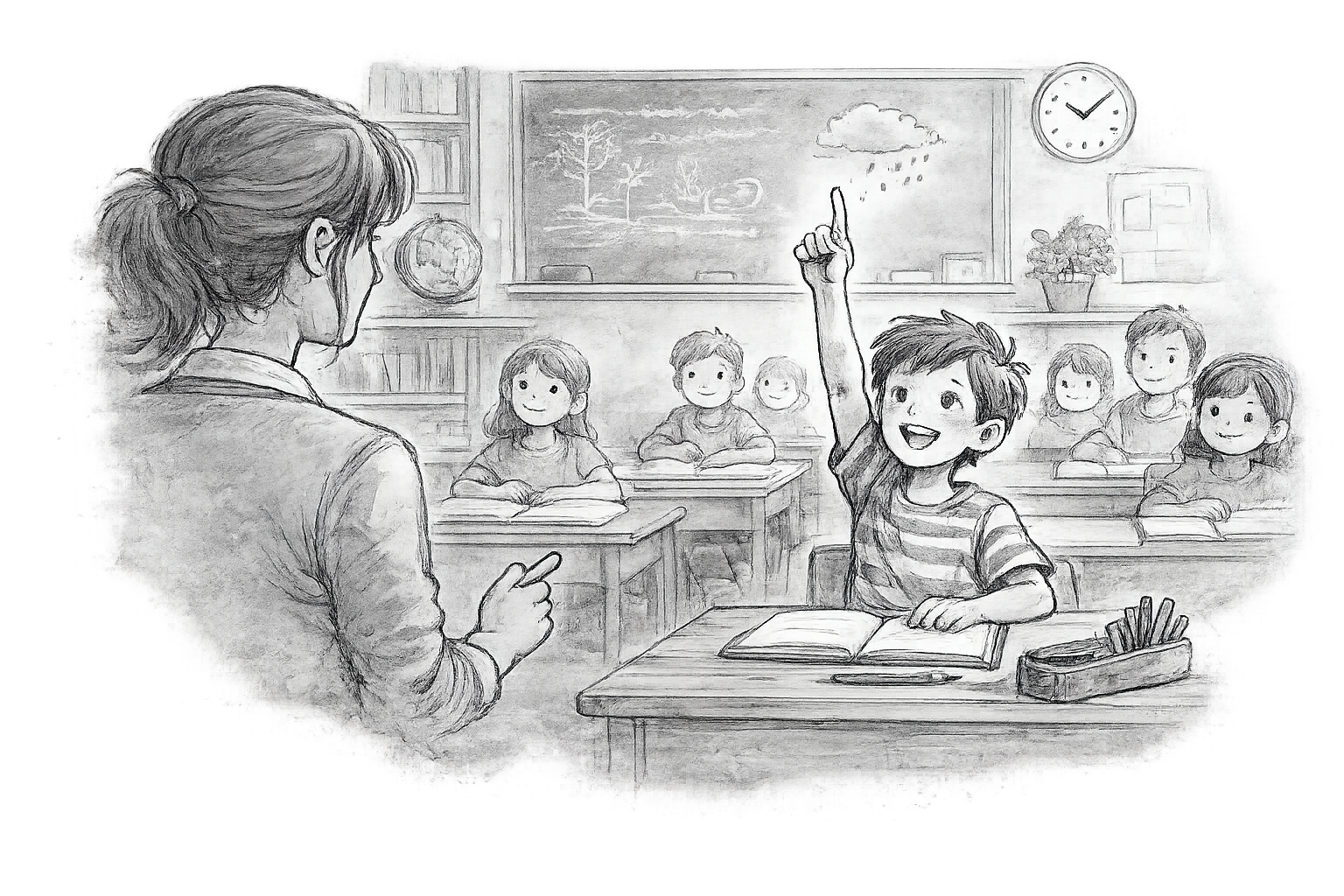
“Teacher… what is biodiversity?”
The question lands in the middle of a dictation—like a hedgehog on a soccer field.
You could answer: “It’s the whole set of living things…”
But you know full well that, behind it, other questions are lying in wait:
-
“Why are we seeing fewer insects?”
-
“Is it serious?”
-
“And can we do anything about it?”
That’s exactly where ESD steps in: not as a “fun Friday activity,” but as a compass. A way to help students understand a world that’s changing—without making them carry the world on their backs (they already have their schoolbags).
ESD isn’t “sorting waste” (even if sorting is good)
Sometimes ESD has been reduced to a tiny zoo of good intentions:
turn off the light, close the tap, put the paper in the right bin.
Useful, yes. But it’s not the heart of the matter.
The heart is this: learning to think about reality.
When it’s done well, ESD teaches students to:
-
observe (really observe, not “I saw something go by”),
-
question (instead of repeating),
-
form hypotheses (without confusing hypothesis and truth),
-
check (with measurements, comparisons, sources),
-
discuss (without throwing opinions at each other).
In short: ESD is a school of investigation. And investigations often calm fears because they put things back in order.
Why it’s become essential (and not just “trendy”)
Before, the environment was a chapter.
Today, it’s the set.
Students are already living with:
-
hotter summers,
-
rain events that overflow,
-
news that scrolls too fast,
-
adults’ debates that contradict each other,
-
and sometimes a small, wordless worry that whispers: “Where are we going?”
School has a mission that no one else fulfills quite as well:
turning the noise of current events into knowledge, method, and landmarks.
And that isn’t “doing politics.”
It’s pedagogy: learning to distinguish what we know, what we believe, what we don’t know and how we move forward.
The schoolyard: that overlooked safari
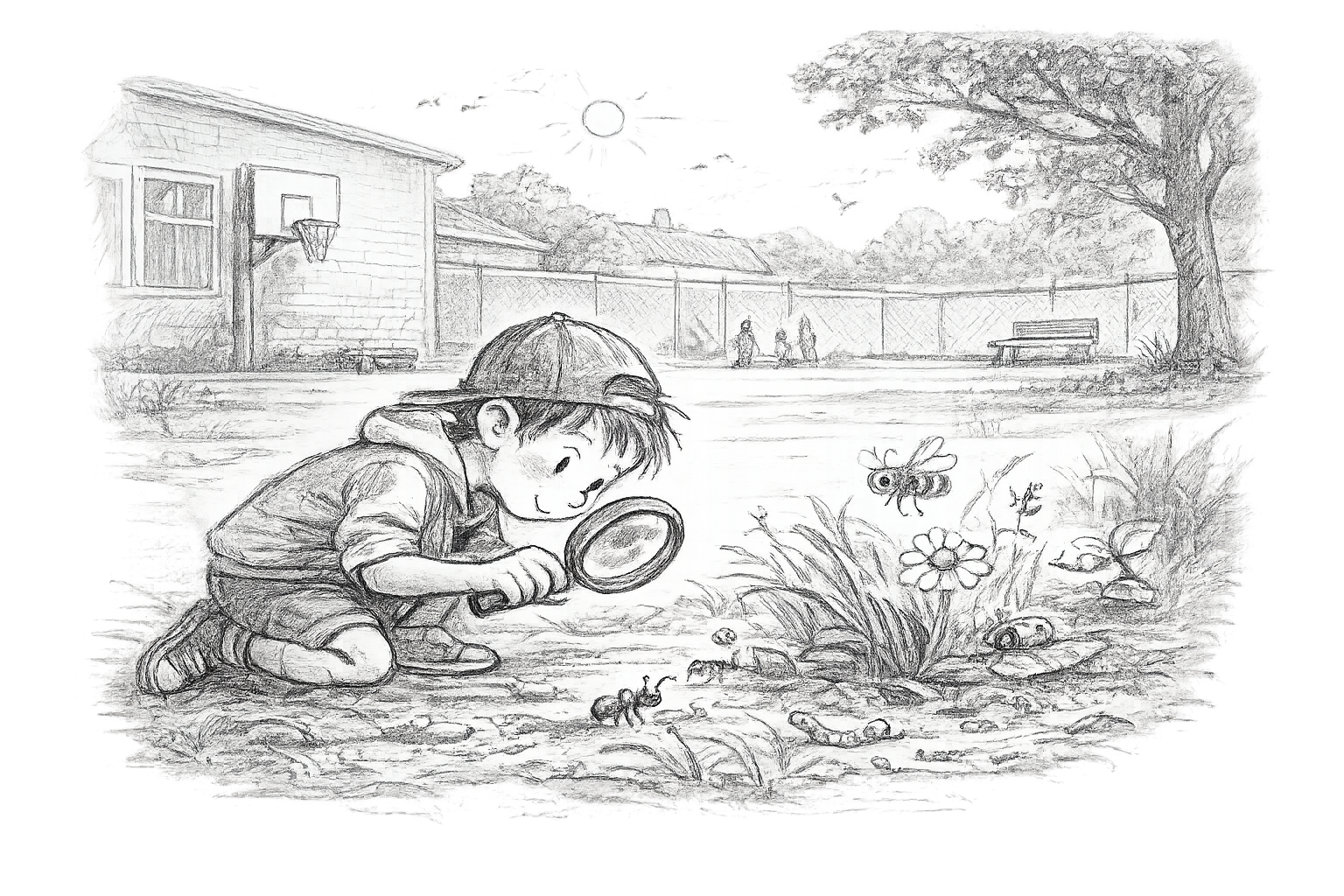
No tropical rainforest at hand? Perfect: start with the yard.
A schoolyard is:
-
a mineral desert (asphalt),
-
a patchwork savannah (grass squares),
-
an oasis (the shady corner),
-
an occasional wetland (the puddle that refuses to die),
-
and sometimes a hedge (where things hide without having asked for parental permission).
You can do ESD there without spending a euro and without any exceptional field trip.
All you need is a rare tool: your eyes (and maybe a thermometer, but it’s not required).
Two dangers to avoid (or ESD turns into a sermon)
1) Total collapse at age 10
If ESD becomes a string of disasters, students do two things:
-
either they panic,
-
or they disconnect (with remarkable talent).
The best antidote: method.
When you investigate, you breathe. You move from “this is scary” to “I understand; I can explain.”
2) Guilt-tripping with a concrete backpack
No, a second-grader isn’t responsible for global trade.
No, a class shouldn’t have to “save the planet” between swimming lessons and verb conjugations.
ESD isn’t “be perfect.”
It’s: learn, cooperate, act at your scale, and understand the collective.
Three simple recipes (tested on school populations)
Recipe #1: The Living Minute (3–5 minutes)
Do it whenever you want, even on a tough Monday.
Option A - “We listen”
Window slightly open (or not). One minute. Then:
-
what did we hear?
-
near/far?
-
natural/technical?
-
same as yesterday?
Option B - “The detail”
A tiny element: a leaf, a feather, a seed, a photo.
Describe it precisely. Forbidden: saying “it’s pretty” as your only scientific information. (You may say it afterward.)
Result: you train students to describe, compare, argue. And that’s French, science, speaking skills… without looking like it.
Recipe #2: The Investigation Lesson (45 minutes - effective as a pair of binoculars)
The foolproof plan:
-
Observation: look at the yard / a photo / a small phenomenon
-
Question: “Why here and not there?”
-
Hypotheses: 2 or 3 maximum (otherwise it’s a circus)
-
Checking: measurements, comparisons, documents
-
Conclusion: what we know + what we don’t know yet
Examples that work every time:
-
Where is it hottest in the schoolyard? (sun/shade, materials, vegetation)
-
Where does water disappear fastest after rain? (infiltration/runoff)
-
Who lives in the cracks? (pioneer plants, micro-habitats)
-
Which birds visit the school? (behaviors, resources, seasons)
Recipe #3: The Mini Biodiversity Atlas of the School (4 weeks)
The “big impact / low stress” project.
-
Week 1: map the zones (asphalt, grass, hedges, corners)
-
Week 2: observe and record (plants, insects, birds, traces)
-
Week 3: understand (habitats, needs, seasons, disturbances)
-
Week 4: propose 2 realistic actions + share results
Realistic actions = not “we plant the Amazon rainforest.”
Instead:
-
create a shady corner / refuge,
-
reduce unnecessary lighting (if it’s the building),
-
protect a hedge,
-
set up an observation spot,
-
post a simple charter.
Possible sharing: exhibition, guided walk, podcast, collective journal.
And then magic: students become experts in their own place. They speak with pride. They pass it on.
The compass phrase (to pin somewhere in your head)
Understand → Feel → Act → Share
-
Understand: method, evidence, orders of magnitude
-
Feel: connection to the living world (without melodrama)
-
Act: small, concrete, collective
-
Share: explain, present, pass it on
Conclusion (with a bonus blackbird)
ESD isn’t an extra subject.
It’s a way of doing school in a changing world: learning to look, understand, discuss, and act together. Not to manufacture perfect students, but to form capable ones.
And if, one morning, someone asks you:
-
“Will there still be birds when I’m grown up?”
You’ll be able to answer without bluffing: -
“We’re going to investigate. And we’re going to learn to do our part… intelligently.”